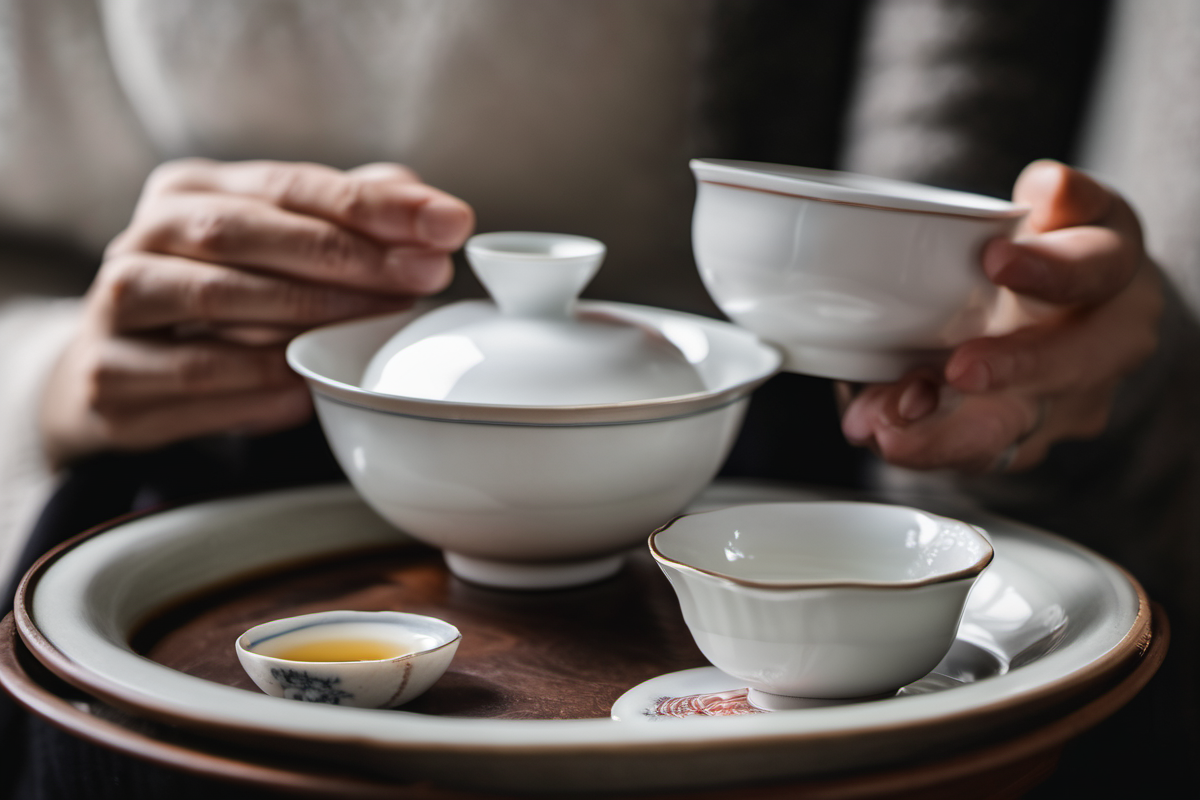
A gaiwan is the single best first teaware purchase for anyone getting into Chinese tea. It’s versatile, affordable, and works for every tea type. But the gaiwan aisle is also full of options — sizes from 60 ml to 300 ml, materials from thin porcelain to thick glazed ceramic, shapes from simple bowls to elaborate carved lids — and it’s easy to pick the wrong one for your first.
This guide gives you a clear, decision-focused walk-through: what size to buy, what material to choose, what shape is forgiving for beginners, and what to skip. By the end you’ll know exactly which gaiwan to order.
If you want a fuller teaware foundation, see our essential teaware for gongfu tea and our gaiwan vs teapot comparison first.
The 30-Second Answer
For a beginner’s first gaiwan, get:
- Size: 100 ml(or 110–130 ml if you regularly brew for two)
- Material: thin white porcelain, glazed inside and out
- Shape: “three talents” (三才) — wide rim, gentle curve, fitted lid with a notch or open spout
- Origin: Jingdezhen porcelain is the classic; Dehua white porcelain is the modern standard
- Budget: $15–30
Anything else (different size, different material, elaborate shapes) is a tradeoff you don’t need to think about for your first piece.
The One Decision That Matters Most: Size
Gaiwan size affects everything else — how much tea you can brew, how easy it is to handle, how stable the lid grip is. Most beginners pick the wrong size; here are the actual sweet spots.
| Size | Best for | Beginner-friendly? |
|---|---|---|
| 60–80 ml | Solo drinking, very concentrated gongfu | Too small for most — hard to grip |
| 100–110 ml | Solo gongfu, learning the grip | Yes — the standard beginner size |
| 120–150 ml | Solo or 2-person brewing | Excellent — comfortable, versatile |
| 170–200 ml | 2–3 people, larger volumes | Heavier; lid grip gets harder |
| 250 ml+ | Big groups, party brewing | Not a beginner’s gaiwan |
The 100–110 ml range is the sweet spot for a first gaiwan. It’s small enough that the lid stays cool and your grip stays stable, large enough to brew 2 small cups of tea, and the standard size used in Chinese tea classes and tasting rooms $TRAE_REF.
If you regularly brew for two people or want a bit more headroom, 120–150 ml is fine — just make sure the rim is wide enough for your grip $TRAE_REF.
If you’re brewing for 3+ people regularly, you’ll want a teapot or a much larger gaiwan (170 ml+), and at that size, the lid grip becomes harder.
Material: What to Choose and Why
Material matters because it affects how the gaiwan tastes the tea, how it handles heat, and how durable it is.
White Porcelain (Highly Recommended for First Gaiwan)
White porcelain is the classic beginner material and what most tea professionals use for tasting. It’s neutral (doesn’t add or absorb flavor), easy to clean, affordable, and the white color lets you judge the actual color of the tea liquor.
Two main origins:
| Origin | Character | Notes |
|---|---|---|
| Jingdezhen(景德镇) | The historical porcelain capital of China; finer, thinner, more refined | The traditional gold standard. Slightly more expensive. Used in imperial porcelain workshops for centuries $TRAE_REF |
| Dehua(德化) | Modern workhorse; clean white porcelain, slightly thicker, very functional | The bulk of mid-range gaiwans today come from Dehua in Fujian. Excellent quality at $15–30 |
For a first gaiwan, Dehua or Jingdezhen white porcelain in the 100–150 ml range is the right choice.
What to look for:
- Thin walls (under 3 mm if possible). Thin porcelain retains heat less aggressively and feels more refined. Thick “hotel” porcelain is clunky and doesn’t let you feel the tea as well.
- Smooth glaze inside and out — any rough spots will trap tea oils and stain over time.
- White or off-white color — not essential, but white makes it easier to judge the liquor color.
- No cracks or rough seams — flip the gaiwan over and check the foot ring; sharp seams mean poor firing.
Other Materials to Know About
| Material | Flavor impact | Best for | Verdict for first gaiwan |
|---|---|---|---|
| White porcelain | Neutral | All teas | Best choice |
| Celadon / qingci (青瓷) | Slightly sweetens the liquor | Mostly aesthetic | Nice second gaiwan |
| Yixing clay | Absorbs and enhances over time | Dedicated to one tea family | Avoid as first gaiwan |
| Glass | Neutral, weak heat retention | Visual brewing | Not great for gongfu |
| Smoked / dark-glazed pottery | Reacts with tea | Decorative only | Not recommended |
Avoid Yixing clay for your first gaiwan. Yixing pots (and Yixing gaiwans) absorb and retain flavor over time. If you use it for multiple teas, the flavors muddle. After a few months of brewing different teas in your Yixing gaiwan, it will make everything taste vaguely the same — and that’s the opposite of what you want when you’re learning to taste tea.
White porcelain is the honest mirror of the tea. Use it first; once you know which tea you love, then consider a Yixing vessel dedicated to that one tea.
Shape: What to Look For
The shape of a gaiwan affects how easy it is to grip, how it pours, and how it feels in your hand. Beginners often pick shapes that look elegant but are functionally awkward. Here are the elements that matter.
The “Three Talents” (三才盖碗) — Best for Beginners
The classic “three talents” gaiwan (sancai gaiwan / 三才盖碗) is the standard design you’ll see in every Chinese tea shop:
- Bowl (bottom) — holds the tea
- Lid (top) — controls pour
- Saucer (base) — catches drips and lets you set it down
The shape features a gentle outward curve, a slightly flared rim, and a lid that fits snugly but with enough play to tilt for pouring.
Why it’s beginner-friendly: the wide flared rim is easy to grip with thumb + index + middle finger; the lid has enough gap to pour smoothly; the saucer catches spills while you learn.
Shape Features That Matter for Beginners
| Feature | What to look for | Why it matters |
|---|---|---|
| Rim flare | Outward-flared rim (not straight or inward) | Easier thumb-and-finger grip, less heat transfer |
| Lid fit | Snug but loose enough to tilt 30–45° | Lets you control pour speed |
| Lid knob | Small, easy to grip with thumb | Larger knobs look nice but are harder to control |
| Foot ring | Slight raised foot on the bottom | Prevents heat transfer to the saucer |
| Wall thickness | Thin (under 3 mm) | Faster cooling, easier to feel the tea |
| Weight (empty) | Under 200 g for 100 ml | Heavy gaiwans are tiring for repeated use |
Shapes to Avoid as a First Gaiwan
- Tall, narrow gaiwans — look elegant but the narrow rim makes the lid grip awkward and the tall walls trap heat
- Heavy “ceremonial” gaiwans — thick walls and heavy weight make them harder to handle and brew inconsistently
- Carved or decorated gaiwans with raised patterns — food safety concerns if the decoration is in the glaze; harder to clean; the decoration can interfere with grip
- Tiny 60–80 ml gaiwans — too small for comfortable grip
- “Artisan” gaiwans with off-center lids — aesthetically interesting but practically frustrating
A plain, well-proportioned, thin-walled white porcelain “three talents” gaiwan is your best friend. Save the artisanal pieces for your second gaiwan when you know what you like.
Lid Anatomy: The Pour Control
The lid is what makes the gaiwan pour. Understanding the small details helps you pick one that pours well.
| Lid feature | What to look for |
|---|---|
| Lid thickness | Thin — thick lids retain heat and burn your thumb |
| Lid knob shape | Small, low-profile; not too tall or wide |
| Lid knob grip | Textured or grooved is helpful; smooth can be slippery when wet |
| Pour spout | Some gaiwans have a small notch or natural gap; some rely on tilting the lid. Either works — try before you commit. |
When you’re browsing online, look for photos that show the lid from the side so you can see the profile. A lid that comes to a rounded peak is usually easier to grip than a perfectly flat lid.
How to Test Before You Buy (If Possible)
If you can visit a tea shop or attend a tasting:
- Pick up the empty gaiwan — does the rim flare feel natural under your fingers? Can your thumb rest comfortably on the lid?
- Do a dry pour — fill with water and pour. Does the lid stay in place? Does water come out in a steady stream or splash?
- Check the weight — pick it up full of water. Is it manageable for 10+ pours in a session?
- Look at the inside — is the glaze smooth and even? Any pinholes or rough spots?
If buying online without touching first, stick to the dimensions and shape recommendations above, and buy from a vendor with a clear return policy.
What About the Saucer?
The saucer (托 / tray) is the third piece of the “three talents” set. It’s usually included with the gaiwan.
- Wide saucers catch drips effectively and look balanced
- Narrow saucers are more elegant but catch fewer spills
- Saucer height — should be roughly the same height as the bowl’s foot ring to look balanced
A simple wide saucer is best. Avoid saucers with raised decorations that might trap water.
Price and What You Get
| Price range (USD) | What to expect | Verdict |
|---|---|---|
| Under $10 | Mass-produced, often Dehua porcelain, basic shape | OK starter if on a budget |
| $15–30 | Good Dehua or Jingdezhen, thin walls, clean finish | Best value — what to aim for |
| $30–60 | Better Jingdezhen porcelain, possibly hand-finished | Worth it if you’ll use it daily |
| $60–150 | Hand-thrown Jingdezhen, “artisan” finishing | For when you know you love gongfu |
| $150+ | Signed artisan pieces, museum-quality | Collector items, not beginner gear |
Don’t over-spend on your first gaiwan. The first one will probably get bumped, dropped, or stained. A $20–30 Dehua or Jingdezhen gaiwan gives you 90% of the function of a $100 one. Once you know what you like, then spend more.
Common Beginner Mistakes to Avoid
Buying a Gaiwan That’s Too Big
The biggest beginner mistake. A 200 ml gaiwan looks impressive, but at that size:
– It’s heavy when full
– The lid is harder to grip with one hand
– You waste tea (gongfu ratios at 200 ml need 12–14 g of leaf per session)
– Heat retention is too aggressive for delicate teas
Stick to 100–150 ml for your first piece.
Buying for Looks Instead of Function
Painted gaiwans, carved gaiwans, blue-and-white porcelain gaiwans, “ruyi” handle gaiwans — these can look beautiful, but for a beginner they introduce problems:
– Painted decoration can affect grip
– Carved exteriors trap tea oils and stain
– Decorative handles change the pour mechanics
– You don’t yet know if you’ll actually enjoy gongfu brewing
Buy a plain, functional piece first. Treat your second gaiwan as an aesthetic upgrade after you’ve mastered the basics.
Buying a “Tea Set” That Includes a Gaiwan
Most entry-level “tea sets” pair a tiny 60–80 ml gaiwan with cheap cups and a teapot. The gaiwan in these sets is almost always too small to learn on, too thick-walled to handle well, and not worth the bundled price. Buy the gaiwan separately.
Buying Yixing as Your First Gaiwan
Already covered, but worth repeating: Yixing absorbs and retains flavor over time. If you use it for green tea on Monday and oolong on Tuesday, the pot will eventually make both teas taste the same. Use porcelain for your first 6+ months; revisit Yixing later when you know which tea you love enough to dedicate a vessel to.
Vendor Recommendations by Budget
I won’t name specific shops here — there are many good ones in China, Taiwan, and Western tea-importing communities. Instead, here’s what to look for at each budget tier:
| Budget | What to look for in the listing |
|---|---|
| Under $15 | “Dehua porcelain” or “Jingdezhen porcelain” + clear photo of lid from the side + dimensions in mm (not just ml) |
| $15–30 | Same plus explicit dimensions (height, rim diameter, capacity in ml) + review photos from buyers showing the lid grip |
| $30–60 | Hand-thrown Jingdezhen + artisan signature + clear weight + thinner walls (under 3 mm) |
| $60+ | Signed artisan pieces; only buy if you know the maker or have tasted the shop’s tea in person |
Red flags:
– No dimensions given (just “100 ml” with no rim diameter)
– Photos showing a perfectly flat lid with a wide knob (hard to grip)
– “Hand-painted” decoration on the rim where you’d hold it
– Brand-new sellers with no customer reviews
– “Yixing gaiwan” under $30 (genuine Yixing is expensive)
Care and Maintenance
Your first gaiwan needs almost no special care. A few simple rules:
- Rinse with hot water only — no soap needed for daily use; soap is fine occasionally if you want to deep-clean
- Air dry upside down on a clean cloth after washing
- Avoid thermal shock — don’t pour boiling water into a cold gaiwan straight from the fridge; let it warm up first
- Don’t stack heavy items on top — porcelain chips if dropped or knocked
- Tea stains are normal — over time the inside may develop light tea-colored staining; this is cosmetic only and doesn’t affect taste
- If a chip appears, the gaiwan is still usable but the chip will get worse over time. Replace when you can.
FAQ
What size gaiwan do I need?
For one person, 100–110 ml. For two people or for everyday versatility, 120–150 ml. Avoid anything over 200 ml as a first gaiwan — it’s heavy and the lid grip becomes awkward.
Is Jingdezhen or Dehua porcelain better?
Both are excellent. Jingdezhen is the historical porcelain capital with a longer tradition and slightly finer, thinner work; Dehua is the modern workhorse producing the bulk of mid-range gaiwans today. For a beginner’s first gaiwan, either is fine — choose based on budget and aesthetics, not “quality,” because both are very good.
Why do some gaiwans have a small notch in the rim?
A small notch or carved spout at the rim gives the tea a controlled pour spout without requiring the user to tilt the lid. Some drinkers prefer notched gaiwans because they pour more predictably. Either design works — try both if you can.
How much should I spend on my first gaiwan?
$15–30 is the right range for most beginners. Below $15 the quality is inconsistent; above $30 you’re paying for artisan finishing you don’t yet know how to appreciate. Once you’ve used the gaiwan for 2–3 months and know you like gongfu, you can upgrade.
Can I use a gaiwan for Western-style brewing (large mug)?
Not really — a gaiwan is designed for short, concentrated gongfu steeps. For Western-style 2–3 minute steeps in a 250 ml mug, use an infuser or a small teapot. See our gaiwan vs teapot comparison for when to use each.
Should I buy a gaiwan with a saucer or without?
For your first gaiwan, with a saucer (“three talents” 三才 set). The saucer catches drips while you’re learning, makes the gaiwan easier to set down between steeps, and gives you the classic gongfu presentation. Bare-bowl gaiwans (without saucer) are a stylistic choice for experienced drinkers who don’t need the drip-catching function.
How long will a porcelain gaiwan last?
Decades, with reasonable care. Porcelain doesn’t wear out from use. It can chip if dropped or knocked, but the material itself is essentially immortal. Many gongfu drinkers use the same first gaiwan for 10+ years. See our best gaiwan for beginners guide for vetted recommendations.
Is a thicker gaiwan better than a thin one?
Thin is better for a beginner, for three reasons:
1. Thin porcelain cools faster, which actually helps delicate teas (green, white, light oolong) brew better
2. Thin walls let you feel the temperature of the tea through the bowl — useful when learning
3. Thin gaiwans are lighter, so repeated pouring is less tiring
“Thick” hotel-style porcelain is more durable but harder to brew well with.
Further Reading
- How to Use a Gaiwan — step-by-step on the grip and pour
- Best Gaiwan for Beginners — vetted picks at every budget
- Gaiwan vs Teapot — when to use which
- Essential Teaware for Gongfu Tea — the full starter kit
- How to Brew Chinese Tea (Complete Guide) — foundational method
- Chinese Tea Brewing Temperature Guide — water temp reference
- How to Brew Tieguanyin — a floral oolong in a porcelain gaiwan
Categories: Teaware
2 thoughts on “How to Choose Your First Gaiwan: A Beginner’s Buying Guide”