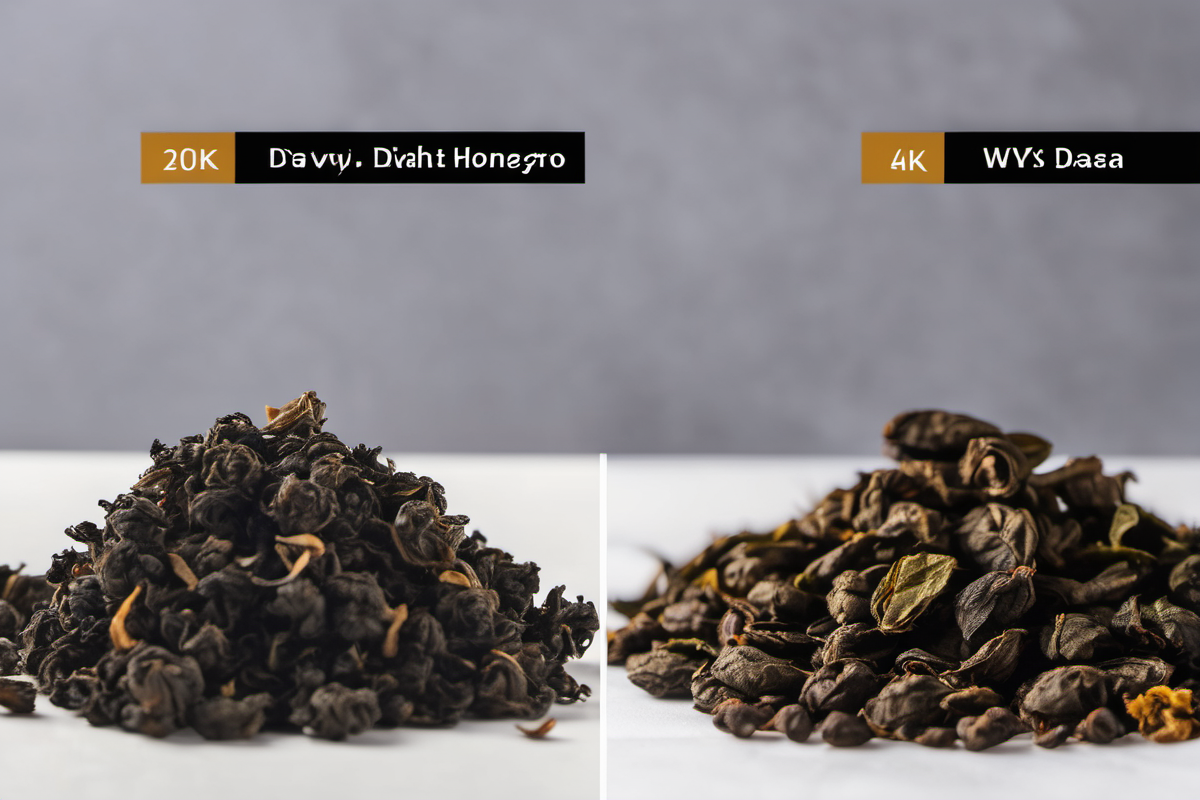
Tieguanyin and Da Hong Pao are China’s two most famous oolong teas. They’re often mentioned together, sometimes confused, and frequently the two oolongs every beginner encounters first. But they sit at opposite ends of the oolong spectrum: Tieguanyin is light, floral, and creamy; Da Hong Pao is dark, roasted, and mineral.
This guide gives you a clear side-by-side comparison — flavor, origin, processing, brewing, caffeine, price — and a simple decision framework for which one to try first based on what you actually enjoy drinking.
If you’re still learning the basics, start with our complete Chinese tea brewing guide and our oolong tea introduction, then come back for the comparison.
The 30-Second Answer
| Pick this | If you want… |
|---|---|
| Tieguanyin | A light, floral, easy-to-brew oolong that drinks like green tea with extra complexity. Best for beginners, hot weather, and people who already like green or white tea. |
| Da Hong Pao | A bold, roasted, mineral oolong that drinks more like coffee. Best for cold weather, people who like dark/black tea or whisky, and drinkers ready for a more intense experience. |
If you’re new to oolong, start with Tieguanyin (specifically, the modern green-fresh / Qing Xiang style). It’s more forgiving, easier to brew, and immediately shows what makes oolong special. Then try Da Hong Pao when you want to explore the roasted, mineral side of the category.
Side-by-Side Comparison
| Trait | Tieguanyin | Da Hong Pao |
|---|---|---|
| Chinese name | 铁观音 | 大红袍 |
| English name | Iron Goddess of Mercy | Big Red Robe |
| Origin | Anxi, southern Fujian | Wuyi Mountains, northern Fujian |
| Style of oolong | Light, green-style (or roasted) | Heavy, roasted |
| Oxidation | 8–25% | 40–70% |
| Roasting | None to light | Charcoal-roasted 2–4 times |
| Leaf shape | Tightly rolled balls / pellets | Long twisted strips |
| Dry leaf color | Green to dark green | Dark brown to black |
| Liquor color | Pale gold to bright amber | Deep amber to mahogany |
| Core aroma | Orchid, floral, creamy, butter | Roasted, caramel, ripe fruit, mineral |
| Signature quality | Huigan(returning sweetness) | Yan yun(rock rhyme / minerality) |
| Mouthfeel | Smooth, soft, light-medium body | Full, heavy, mouth-coating |
| Caffeine per cup | 30–50 mg | 40–70 mg |
| Gongfu infusions | 7–10 | 8–12+ |
| Best water temp | 90–95°C / 194–203°F | 95–100°C / 203–212°F |
| Best vessel | Porcelain gaiwan | Yixing clay teapot, Jianshui pot, or gaiwan |
| Aging potential | Low (drink within 18 months) | High for roasted, well-stored lots |
| Beginner price (USD) | $15–30 for 50g | $20–50 for 50g |
| Premium tier (USD) | $50–200+ per 50g | $80–500+ per 50g |
| Best season to drink | Spring, summer | Autumn, winter |
| Difficulty to brew | Easy | Easy to moderate |
Origin and Terroir
Both teas come from Fujian Province in southeastern China, but from completely different mountains.
Tieguanyin is grown around Anxi(安溪)in southern Fujian, a sub-tropical lowland region known for tea gardens and orchids. The climate is warm, humid, and gentle. Anxi teas are the floral, easy-drinking oolongs most international drinkers start with.
Da Hong Pao is grown in the Wuyi Mountains(武夷山)in northern Fujian, a UNESCO World Heritage Site of steep, rocky cliffs and winding rivers. The famous “rock teas”(岩茶, yan cha)grow in mineral-rich rocky soil, and their distinctive yan yun — “rock rhyme” — is said to come from this terroir. Wuyi teas are roasted, mineral, and intense.
Think of it this way: Tieguanyin is the sunny hillside garden; Da Hong Pao is the cliff-face crag $TRAE_REF.
How They’re Processed
Tieguanyin
Modern Tieguanyin (the green-fresh / Qing Xiang style) goes through light oxidation and minimal roasting $TRAE_REF:
- Picking (mostly one bud with 2–3 leaves)
- Solar withering
- Light shaking and rolling to start gentle oxidation (8–25%)
- Pan-firing to halt oxidation
- Rolling into the characteristic tight balls
- Light or no roasting
The result is a tea that drinks close to green tea but with more complexity — floral, slightly creamy, and very aromatic.
Da Hong Pao
Da Hong Pao goes through much heavier oxidation, then charcoal roasting (the bei huo 焙火 step) — sometimes 2 to 4 rounds of slow charcoal roasting in bamboo baskets over weeks or months $TRAE_REF:
- Picking (one bud with 3–4 leaves)
- Solar withering
- Shake-bruising and partial oxidation (40–70%)
- Pan-firing (kill-green)
- Hand-rolling into twisted strips
- Charcoal roasting at 110–140°C, repeated 2–4 times
That last step is what gives Da Hong Pao its characteristic roasted, mineral, caramel character. It also makes the tea exceptionally stable for long-term storage — well-roasted Da Hong Pao can improve for years $TRAE_REF.
Flavor Profile: A Direct Taste Comparison
Tieguanyin Tastes Like
- Floral: orchid (兰花香 lan hua xiang) is the signature note
- Creamy and buttery: think whole milk, fresh butter, sometimes a soft cheese note
- Vegetal but sweet: fresh peas, sweet corn, ripe melon
- Lingering sweetness: huigan (回甘) — a “returning sweetness” in the throat that arrives after you swallow
- Cooling finish: a slight cooling sensation in the back of the throat
Da Hong Pao Tastes Like
- Roasted: toasted nuts, dark caramel, sometimes toasted bread
- Mineral: wet stone, slate, clay — the yan yun
- Ripe fruit: stone fruit, dried plum, baked apple
- Cocoa and brown sugar: especially in mid-infusions
- Long, warm finish: the roast lingers in the chest, not just the throat
Quick Test
If you can’t decide which one you’d prefer, try this mental test:
- Tieguanyin is to oolong what a light, aromatic white wine is to wine — floral, elegant, easy to drink in summer
- Da Hong Pao is to oolong what a smoky single-malt whisky is to spirits — bold, complex, more intense, drinks beautifully in winter
Both are great. They’re just very different $TRAE_REF.
Brewing Comparison
Both teas are gongfu-brewed, but the parameters differ.
| Brewing Parameter | Tieguanyin (green-fresh) | Da Hong Pao |
|---|---|---|
| Water temperature | 90–95°C / 194–203°F | 95–100°C / 203–212°F |
| Gongfu ratio | 5–7 g per 100–120 ml | 7–8 g per 100–150 ml |
| First steep | 10–15 sec | 10–15 sec |
| Subsequent adds | +5–10 sec each | +5–10 sec each |
| Vessel | Porcelain gaiwan | Yixing clay teapot, Jianshui pot, or gaiwan |
| Rinse | Optional | Yes (3–5 sec) |
Tieguanyin wants slightly cooler water (because the leaves are delicate and unoxidized) and porcelain (which keeps the aromatics clean and bright) $TRAE_REF.
Da Hong Pao wants hotter water (because the leaves are tightly twisted and heavily roasted — they need heat to open up) and clay is the traditional choice (which softens the roasted edges and rounds out the mineral character) $TRAE_REF.
If you only have a porcelain gaiwan, both teas will brew well in it — you’ll just get a slightly cleaner, more direct expression of Da Hong Pao than you would from a Yixing pot.
Caffeine and Health
| Tea | Caffeine per cup | Best time to drink |
|---|---|---|
| Tieguanyin | 30–50 mg | Morning, early afternoon |
| Da Hong Pao | 40–70 mg | Morning only (especially roasted lots) |
Da Hong Pao contains slightly more caffeine than Tieguanyin, partly because the heavier oxidation and roasting process concentrates the compounds. Both contain roughly 1/3 to 2/3 the caffeine of a cup of coffee $TRAE_REF.
For health, both teas carry the standard oolong benefits: polyphenols (catechins and theaflavins, depending on oxidation level), theanine for calm focus, and modest amounts of antioxidants. There is no “healthier” choice between the two — drink whichever you enjoy.
Price and Value
Both teas span an enormous price range, from everyday drinking quality to collector’s items.
Tieguanyin Pricing
- Everyday grade (Anxi, autumn harvest): $15–30 for 50g — drinkable, light, refreshing
- Mid-range (spring harvest, Anxi protected origin): $40–80 for 50g — balanced, classic flavor
- Premium (single-orchard, pre-Qingming harvest): $150–500+ for 50g — intensely aromatic, complex
Da Hong Pao Pricing
- Everyday blend grade (multiple Wuyi cultivars blended): $20–50 for 50g — solid daily drinker
- Premium blend (Zhengyan or Banyan terroir): $80–200 for 50g — clear mineral character
- Single-cultivar premium(Rou Gui, Shui Xian, Qi Dan): $150–600+ for 50g — distinct, terroir-driven
- “True” Da Hong Pao from the mother bushes: auction prices have run into the millions of dollars per kilogram — not commercially available
For both teas, the sweet spot for everyday drinkers is the $20–60 range for 50g. Above that, you’re paying for rarity and prestige as much as flavor $TRAE_REF.
Which One Should You Try First?
Try Tieguanyin first if…
- You’re completely new to Chinese tea
- You already enjoy green tea, white tea, or light aromatic wines
- You’re brewing in hot weather or want a refreshing afternoon cup
- You want forgiving brewing parameters
- You’re on a tighter budget for “exploration” tea
Recommended: A modern green-fresh (Qing Xiang) Tieguanyin, Anxi origin, autumn or spring harvest. Aim for $20–40 for 50g.
Try Da Hong Pao first if…
- You already enjoy dark/black tea, coffee, or smoky whisky
- You’re brewing in cold weather or want a warming morning cup
- You want a more complex, evolving cup across many infusions
- You already own or are buying a Yixing clay teapot
- You want to age the tea (well-roasted Da Hong Pao can improve with proper storage)
Recommended: A mid-range Wuyi blend with clear yan yun, or a single-cultivar Rou Gui. Aim for $30–80 for 50g.
The Honest Truth
If you have the budget, try both within a week of each other. They reveal different sides of oolong, and most people discover they like one more than the other for clear, identifiable reasons. Once you know which one you reach for first, you’ll know what to buy more of.
Common Confusions Cleared Up
Are Tieguanyin and Da Hong Pao Both Oolongs?
Yes. Both are partially oxidized, but at very different levels — Tieguanyin at 8–25%, Da Hong Pao at 40–70%. They’re as different within oolong as a light Chardonnay and a bold Cabernet Sauvignon would be within white wine.
Is Da Hong Pao a Black Tea?
No. Western “black tea” corresponds to Chinese “red tea” (红茶 hong cha), which is fully oxidized. Da Hong Pao is partially oxidized (40–70%) and is therefore an oolong. The naming confusion comes from translation: Western convention calls fully oxidized teas “black,” while Chinese convention calls the same teas “red” because of the color of the brewed liquid.
Is Tieguanyin a Green Tea?
No. Tieguanyin is oxidized 8–25%, which puts it firmly in the oolong category. Green tea is unoxidized (0%). Modern green-fresh Tieguanyin tastes close to green tea, but the subtle oxidation is what gives Tieguanyin its creamy, layered character that pure green tea lacks.
Which Is Healthier?
Both have similar polyphenol content (slightly different profiles — Tieguanyin is richer in catechins because of lower oxidation; Da Hong Pao has more theaflavins and thearubigins from the heavier oxidation and roasting). Neither is meaningfully “healthier” than the other. Drink whichever you enjoy more.
Can I Drink Both in the Same Day?
Absolutely. Many gongfu drinkers have a daily Tieguanyin (or other light oolong) for afternoon and a Da Hong Pao (or other rock oolong) for morning. The two teas complement each other — light/cool vs heavy/warm.
FAQ
Which is more caffeinated, Tieguanyin or Da Hong Pao?
Da Hong Pao has slightly more caffeine (40–70 mg per cup) than Tieguanyin (30–50 mg per cup). Both are below coffee. If you’re caffeine-sensitive, lean toward Tieguanyin or drink Da Hong Pao only in the morning.
Can I brew Tieguanyin and Da Hong Pao in the same gaiwan without washing in between?
You can, but the flavors will mix. Better to rinse the gaiwan with hot water between teas. If you’re using a Yixing teapot, never mix them — dedicate the Yixing pot to one style only.
Which tea has more infusions, Tieguanyin or Da Hong Pao?
Da Hong Pao typically gives more infusions (8–12+) than Tieguanyin (7–10), because the heavier roasting and tighter leaf structure release flavor gradually across many steeps. Premium single-cultivar Da Hong Pao can stretch to 15+ infusions.
Which is better for iced tea?
Tieguanyin wins for iced tea. Its floral, bright character survives cold brewing beautifully. Use 5 g per 500 ml cold water, refrigerate 6–8 hours, strain. Da Hong Pao can be iced but the roasted character gets muted by the cold — it works better as a hot or warm drink.
Is Da Hong Pao the same as “Big Red Robe”?
Yes. Da Hong Pao (大红袍) is Mandarin Chinese; “Big Red Robe” is the literal English translation. You’ll see both on packaging.
Which one should I buy if I can only afford one?
If you’re new to oolong, Tieguanyin. It’s cheaper, easier to brew, and more forgiving. If you’ve already explored Tieguanyin and want to push into roasted territory, Da Hong Pao is the natural next step.
Further Reading
- How to Brew Tieguanyin — full brewing guide for the floral oolong
- How to Brew Da Hong Pao — full brewing guide for the rock oolong
- What Is Oolong Tea? — context on the broader oolong category
- Green Tea vs Oolong: What’s the Difference? — for drinkers coming from green tea
- How to Brew Chinese Tea (Complete Guide) — the foundational method
- Best Gaiwan for Beginners — choosing teaware for either tea
- Gaiwan vs Teapot — which vessel for each style
- Types of Chinese Tea: Complete Guide — all six tea categories