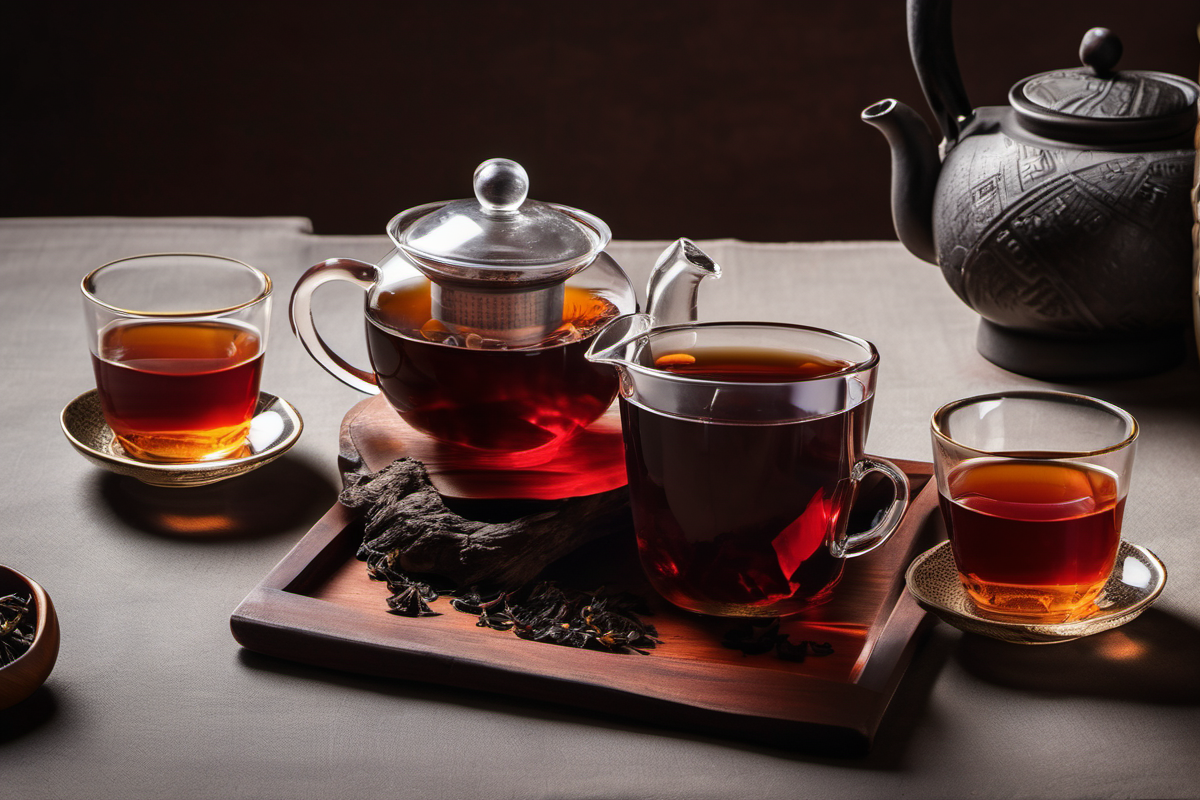
Da Hong Pao(大红袍, “Big Red Robe”)is China’s most famous rock oolong — and the tea that defines what yan cha(岩茶, “rock tea”)means to drinkers worldwide. Its deep, roasted, mineral-driven flavor is unlike any other oolong, and getting it right at home is easier than you think once you understand what you’re brewing.
This guide walks you through exactly how to brew Da Hong Pao using the gongfu method, what temperature and ratio to use, how many infusions to expect, and how to taste the signature yan yun — the mineral “rock rhyme” that makes this tea worth chasing.
If you’re new to gongfu brewing, start with our complete Chinese tea brewing guide and our gongfu tea ceremony walkthrough, then come back here for the Da Hong Pao specifics.
What Is Da Hong Pao?
Da Hong Pao is a heavily oxidized, charcoal-roasted oolong from the Wuyi Mountains(武夷山)in northern Fujian Province, southeastern China. The Wuyi region is a UNESCO World Heritage Site, and the tea grown in its rocky, mineral-rich cliffs is collectively called yan cha — “rock tea” — because the cliffs themselves are said to flavor the leaves $TRAE_REF.
The legend says a Ming Dynasty scholar, after passing his imperial exams, hung his red robe on a tea bush to dry; the bush repaid him with leaves so extraordinary they were reserved for the emperor. The name “Big Red Robe” stuck, and the original mother bushes on the cliffs are still alive — though production today comes from cuttings and other Wuyi cultivars blended to recreate that original character $TRAE_REF.
What Makes Da Hong Pao Different From Other Oolongs
Three things separate Da Hong Pao from lighter oolongs like Tieguanyin:
| Trait | Da Hong Pao | Tieguanyin |
|---|---|---|
| Origin | Wuyi Mountains, northern Fujian | Anxi, southern Fujian |
| Oxidation | 40–70%(medium-heavy) | 8–25%(light) |
| Roasting | Charcoal-roasted in 2–4 sessions | Light or unroasted |
| Flavor | Roasted, mineral, ripe fruit, caramel | Floral, orchid, creamy, vegetal |
| Signature quality | Yan yun(rock rhyme)— wet-stone minerality | Huigan(returning sweetness) |
Both teas are oolongs, but they sit at opposite ends of the oolong spectrum. Once you’ve tasted them side by side, you’ll never confuse them $TRAE_REF.
A Note on “True” Da Hong Pao
The original mother bushes produce only a few kilograms of tea a year — auction prices run into the millions of dollars per kilogram. What you buy as “Da Hong Pao” today is almost always a blend of Wuyi cultivars (often Shui Xian, Rou Gui, or other yan cha varieties) blended and roasted to evoke the original character. This is industry standard and not a fake — it’s how the tea has been made for decades. If you want single-cultivar Wuyi tea, look for Qi Dan, Rou Gui, or Shui Xian on the label $TRAE_REF.
Quick Answer: How to Brew Da Hong Pao
If you only have 30 seconds:
- Water temperature: 95–100°C / 203–212°F(rolling boil or just off)
- Gongfu ratio: 7–8 g per 100–150 ml
- Gongfu steep time: 10–15 seconds for the first steep, add 5–10 seconds each round
- Vessel: Yixing clay teapot, Jianshui clay teapot, or porcelain gaiwan
- Re-steeps: 8–12+ in gongfu; quality Wuyi easily gives 10+
- Rinse: Yes — 3–5 seconds, then discard
Now let’s go deeper.
What You Need
| Item | Why It Matters | Budget Option |
|---|---|---|
| Yixing or Jianshui clay teapot(100–150 ml) | The traditional vessel — clay adds warmth and rounds out roasted flavors | Small unglazed clay pot dedicated to rock teas |
| Porcelain gaiwan(100–150 ml) | If you don’t have clay yet — neutral material, still excellent | Any 100 ml porcelain gaiwan |
| Kettle that hits 95–100°C | Da Hong Pao needs near-boiling water to release its roasted depth | Boil, then pour immediately |
| Scale(0.1 g precision) | Rock teas are tightly twisted; eyeballing the ratio is unreliable | Any kitchen scale |
| Filtered or spring water | Hard or chlorinated water mutes the mineral character | Brita pitcher or spring water |
Vessel choice matters more for Da Hong Pao than for almost any other tea. The traditional choice is a small unglazed clay teapot — either Yixing(zisha clay from Jiangsu)or Jianshui clay from Yunnan. Clay “breathes” and gently rounds out roasted, mineral edges over time. A Yixing pot dedicated to rock teas develops depth after a few sessions $TRAE_REF.
If you only have a porcelain gaiwan, that’s fine too — you’ll get a cleaner, more direct expression of the tea’s flavor without the clay’s softening effect. See our best gaiwan for beginners guide if you’re buying your first one, or essential teaware for gongfu tea for the complete starter kit.
Step-by-Step: Gongfu Method
Da Hong Pao is made for gongfu brewing. High leaf ratio + short steeps + many infusions lets you walk through the tea’s evolution: bright and roasted at the start, deeper and sweeter in the middle, returning to subtle mineral notes at the end.
1. Warm the Vessel
Pour boiling water into your empty teapot or gaiwan, swirl, then pour it into the cups. This is especially important for clay pots — a cold vessel drops the water temperature the moment it hits the leaves, which can mute the first infusion.
2. Add the Leaves
Use 7–8 g of leaf per 100–150 ml of water $TRAE_REF. Da Hong Pao leaves are tightly twisted into long, dark strips — they look smaller than they actually are, so don’t be surprised when 7 g fills the vessel generously.
3. The Rinse(Required)
Pour water over the leaves to cover them, then immediately pour it off and discard — 3–5 seconds total. With Da Hong Pao this step matters more than for most teas because:
- The leaves are heavily roasted, and the rinse clears any loose roasting dust from storage and shipping
- The tight twisted strips need hot water to start unfurling
- It “wakes” the leaves so the first real steep extracts evenly
Don’t drink the rinse. If you do this step right, the pot will smell intensely of roasted, almost coffee-like aroma — that’s a good sign.
4. First Steep
Pour water at 95–100°C / 203–212°F over the leaves, cover, and steep for 10–15 seconds $TRAE_REF. Roll the pot gently between steeps to even out extraction — but only after the lid is on, so the leaves stay submerged.
Pour completely into a fairness pitcher or directly into cups. Don’t leave any water sitting on the leaves between steeps.
5. Repeat
Add 5–10 seconds to each subsequent infusion. A typical progression for good Wuyi tea:
| Steep | Time | What You Should Taste |
|---|---|---|
| 1 | 10–15 sec | Bright roast, caramel, light mineral |
| 2 | 15–20 sec | Ripe fruit (stone fruit, plum), deeper roast |
| 3 | 20–30 sec | Cocoa, brown sugar, mineral emerges |
| 4 | 30–40 sec | Yan yun — wet-stone, minerality in throat |
| 5–7 | 40–60 sec | Sweetness deepens, fruit returns |
| 8–10 | 60–90 sec | Mineral long finish, subtle floral |
| 11–12+ | 90+ sec | Final rounds — clean, sweet, mineral |
A good Wuyi tea gives 8–12 gongfu infusions; premium single-cultivar Qi Dan or Rou Gui can stretch to 15 with patience $TRAE_REF. When the cup starts tasting thin or the wet leaves have fully opened into long, flat strips, you’ve reached the end.
Step-by-Step: Western Method
If you only have a mug, the Western method works — but you’ll lose the layered evolution that makes gongfu special.
- Ratio: 3 g per 250 ml(about 1 heaped teaspoon)
- Temperature: 90–95°C / 194–203°F(slightly cooler than gongfu to avoid over-extraction in the larger volume)
- Steep time: 2–3 minutes
- Re-steeps: 2–3
Use a basket infuser or brew in a small pot and pour through a strainer. Pour every drop out between cups.
The Three Most Common Mistakes
Water Too Cool
Da Hong Pao needs near-boiling water to release its roasted, mineral depth. Water at 80–85°C(green tea range)will give you a thin, dusty cup that tastes nothing like rock tea. If your kettle only boils, that’s fine — pour immediately. There’s no need to “rest” the water for this tea.
Too Little Leaf
Da Hong Pao leaves are tightly twisted strips, deceptively small in volume. Three grams in a 250 ml mug looks like almost nothing — but that’s only enough for one mild infusion. Rock teas need more leaf per water volume than other oolongs to extract properly. Use a scale the first few times; you’ll quickly calibrate what 7 g looks like in your hand.
Skipping the Rinse
With heavily roasted rock teas, skipping the rinse leaves you with a gritty first cup and weaker aroma. The rinse is functional, not optional — it clears the dust and primes the leaves. Three to five seconds, then discard.
How to Tell Good Da Hong Pao from Bad
When you open the bag:
- Dry leaf should be long, twisted, dark brown-to-black strips. Pale, broken, or papery leaves mean the tea is stale or low-grade.
- Aroma should hit you with roast first — coffee-like, caramel, dark cocoa — then a hint of fruit underneath. If it smells flat or smoky in a “burnt” way, the tea was over-roasted.
- Wet leaf should be soft, whole, and dark olive-to-brown after brewing. Black, mushy, or powdery leaves mean poor storage or low quality.
- The liquor should be deep amber-to-rust, clear and bright. Cloudy or dull liquor is a red flag.
Da Hong Pao’s roasted character fades with age, even though the leaf doesn’t go “bad” the way green teas do. For the most vibrant roast character, use the tea within 18–24 months of roasting.
How to Store Da Hong Pao
Da Hong Pao is more stable than lighter teas because of the heavy roast, but it still benefits from basic care:
- Seal airtight between sessions — the original foil pouch works, but a tin with a tight lid is better
- Keep away from light, heat, and moisture — a kitchen cupboard, not a countertop
- Keep away from strong odors — never next to spices, coffee, or the stove
- No refrigeration needed — and don’t refrigerate, because moisture cycles will damage the roast
Some drinkers let Da Hong Pao “rest” in the tin for a few weeks after opening, which is said to let the roast settle. This is optional — fresh Da Hong Pao is also excellent.
FAQ
How many times can you steep Da Hong Pao?
Gongfu-brewed Da Hong Pao gives 8–12 infusions with quality leaves; single-cultivar Wuyi teas can stretch to 15+. Western-brewed gives 2–3 infusions. Add 5–10 seconds to each gongfu steep, or 30–60 seconds for Western, until the cup starts tasting thin.
What temperature should I use for Da Hong Pao?
Use 95–100°C / 203–212°F — near-boiling water. Unlike green or white tea, Da Hong Pao benefits from full heat to release its roasted, mineral character. If your kettle only boils, pour immediately without resting.
Is Da Hong Pao the same as black tea?
No. Da Hong Pao is an oolong, not a black tea. Western “black tea” corresponds to Chinese “red tea” (hong cha, 红茶), which is fully oxidized. Da Hong Pao is 40–70% oxidized and charcoal-roasted — somewhere in the middle of the oolong spectrum. See our comparison guide for the broader oolong picture.
What’s the difference between Da Hong Pao and Tieguanyin?
Both are famous Chinese oolongs, but they taste very different:
- Da Hong Pao — roasted, mineral, ripe fruit, caramel, with the signature yan yun “rock rhyme”
- Tieguanyin — light, floral, orchid, creamy, with huigan returning sweetness
Da Hong Pao comes from the Wuyi Mountains in northern Fujian; Tieguanyin comes from Anxi in southern Fujian. Da Hong Pao needs near-boiling water and a clay or porcelain vessel; Tieguanyin prefers slightly cooler water and porcelain.
How much caffeine does Da Hong Pao have?
Da Hong Pao contains roughly 40–70 mg of caffeine per cup — comparable to black tea and a bit higher than green tea $TRAE_REF. It’s fine for morning and early afternoon drinking; cut off by mid-afternoon if you’re caffeine-sensitive.
Can I use a Yixing teapot for Da Hong Pao?
Yes — and it’s actually the traditional choice. Yixing clay “breathes” and rounds out roasted edges over time. Important: dedicate the Yixing pot to rock teas (Da Hong Pao, Rou Gui, Shui Xian, etc.) and don’t use it for green or floral oolongs like Tieguanyin, because clay absorbs aroma and will mute delicate florals over time. If you’re buying your first clay pot, look for a 100–150 ml unglazed pot made specifically for Wuyi teas.
Why does my Da Hong Pao taste smoky or burnt?
Two possibilities:
1. Over-roasted or poorly roasted tea — cheap Da Hong Pao is sometimes blasted with high heat to mimic traditional roast, producing a “burnt” rather than “toasted” flavor. Buy from a reputable vendor.
2. Brewing issues — water too hot plus too long a steep plus too much leaf can push the roast into bitter territory. Try cooler water(95°C, not 100°C), shorter steeps, and reduce leaf by 1 g.
Further Reading
- How to Brew Chinese Tea(Complete Guide) — the foundational method every Chinese tea drinker should know
- Gongfu Tea Ceremony: Step-by-Step — the broader tradition this brewing style comes from
- How to Use a Gaiwan — if you’re starting with porcelain
- Tieguanyin vs Da Hong Pao: Which Oolong Is Right for You? — the side-by-side comparison
- What Is Oolong Tea? — context on the broader oolong category
- Best Teapot for Loose Leaf Tea — choosing a Yixing or Jianshui pot
- How to Brew Oolong Tea — the general oolong method
- Chinese Tea Brewing Temperature Guide — a complete reference for all six tea types
2 thoughts on “How to Brew Da Hong Pao(大红袍):Gongfu Method for Rock Oolong”