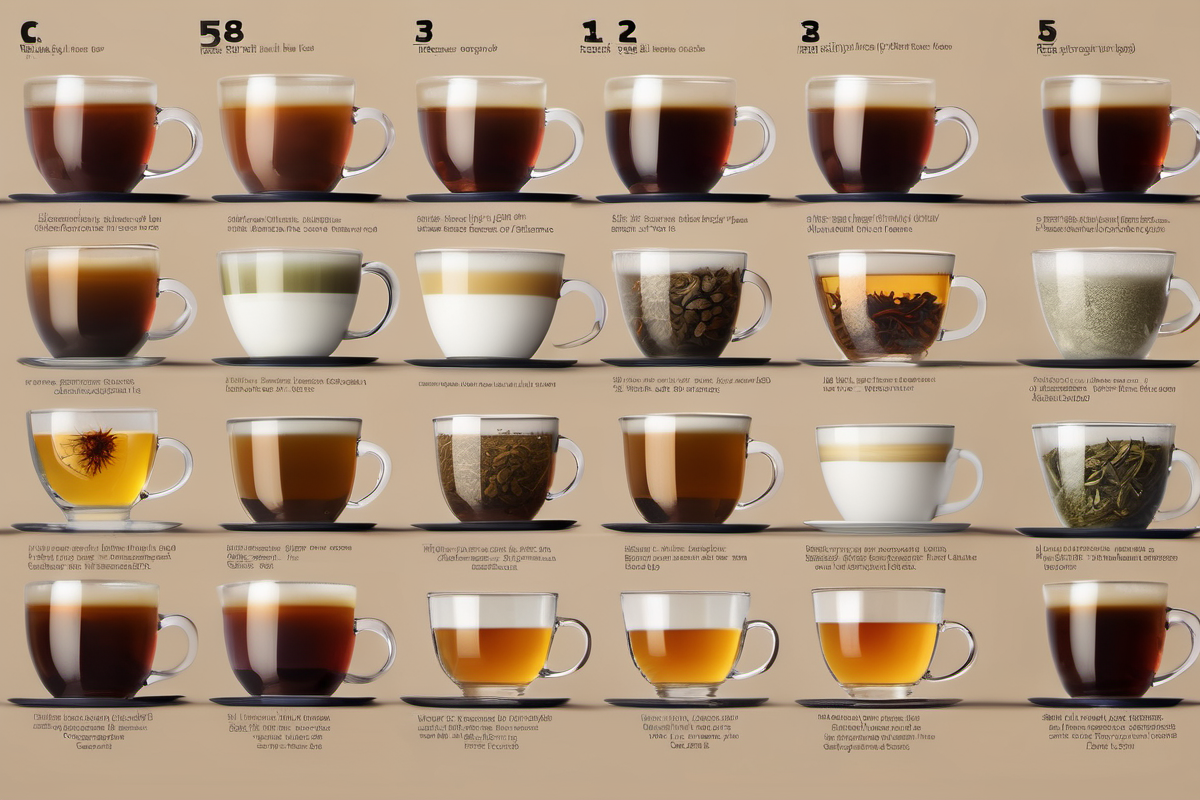
“How much caffeine is in this tea?” is one of the most common questions new Chinese tea drinkers ask. The honest answer: it depends on the tea type, the leaf quality, and how you brew it. But there are real, measurable patterns you can use to plan your day.
This guide gives you the exact numbers for all six Chinese tea categories, what factors change the caffeine in your cup, and how to brew a lower-caffeine version of any tea you love.
If you’re new to the six categories, see our types of Chinese tea guide and our brewing temperature reference first.
The 30-Second Answer
| Tea type | Caffeine per cup (240 ml) | Compared to coffee |
|---|---|---|
| White tea | 15–30 mg | 1/4 cup |
| Yellow tea | 20–35 mg | 1/3 cup |
| Green tea | 25–35 mg | 1/3 cup |
| Oolong tea | 30–50 mg | 1/2 cup |
| Black (red) tea | 40–70 mg | 2/3 cup |
| Pu-erh / dark tea | 30–70 mg (variable) | 1/3 to 2/3 cup |
| Espresso shot (for reference) | 60–80 mg | baseline |
| Drip coffee (for reference) | 80–120 mg | 1–1.5× |
No Chinese tea is caffeine-free. Even the lowest-caffeine options (white and yellow tea) still contain measurable caffeine. If you’re completely caffeine-intolerant, no Chinese tea is safe.
If you’re caffeine-sensitive but want to drink tea, the answer is white tea — it has the lowest caffeine levels of any Chinese tea category, and you can drop caffeine even further by brewing it cool and short.
Caffeine by Tea Type: Detailed Numbers
Numbers below are for a 240 ml cup brewed in a Western-style mug or small teapot (1.5–2 g leaf per 240 ml, 2–3 minute steep). Gongfu brewing changes these numbers — see the next section.
White Tea(白茶) — 15–30 mg per cup
The lowest-caffeine Chinese tea category. White tea is the least processed of all six categories — just withered and dried — and the buds are particularly low in caffeine (and high in the calming amino acid L-theanine).
The buds and young leaves of Silver Needle (白毫银针) test at the low end of the range; White Peony (白牡丹), which uses more mature leaves, tests slightly higher.
| White tea variety | Caffeine per cup |
|---|---|
| Silver Needle (buds only) | 15–20 mg |
| White Peony (bud + 1–2 leaves) | 20–30 mg |
| Shou Mei / Gong Mei (mature leaves) | 25–30 mg |
Best time to drink: morning through late afternoon, including early evening. White tea is the safest choice if you’re cutting back on caffeine.
Yellow Tea(黄茶) — 20–35 mg per cup
Yellow tea is rare outside China, and the numbers are similar to green tea. It’s processed like green tea with an extra “sealed yellowing” step that mellows the flavor.
Best time to drink: morning and early afternoon.
Green Tea(绿茶) — 25–35 mg per cup
Surprisingly moderate, despite green tea’s reputation as a stimulant. The processing (pan-firing or steaming) is fast and the leaf isn’t fully developed, but brewing parameters matter more than category alone.
| Green tea variety | Caffeine per cup |
|---|---|
| Japanese-style sencha | 25–35 mg |
| Chinese pan-fired (Longjing) | 20–30 mg |
| Steamed (e.g., Japanese) | 30–40 mg |
For more on green tea brewing, see our how to brew Longjing guide.
Best time to drink: morning through early afternoon. Avoid within 6 hours of bedtime if you’re caffeine-sensitive.
Oolong Tea(乌龙茶) — 30–50 mg per cup
Oolong sits in the middle of the range. Light oolongs (Anxi Tieguanyin, Taiwanese high mountain) test at the lower end; roasted rock oolongs (Wuyi yan cha) test slightly higher due to more developed leaves.
| Oolong type | Caffeine per cup |
|---|---|
| Light oolong (Tieguanyin, high mountain) | 30–40 mg |
| Medium oolong (Dong Ding, Se Zhong) | 35–45 mg |
| Roasted rock oolong (Da Hong Pao, Rou Gui) | 40–50 mg |
For more on oolong types, see our Tieguanyin vs Da Hong Pao comparison.
Best time to drink: morning and afternoon. Cut off by mid-afternoon if you’re caffeine-sensitive.
Black (Red) Tea(红茶) — 40–70 mg per cup
The highest-caffeine Chinese tea. “Red tea” in Chinese (hong cha, 红茶) corresponds to what Westerners call “black tea” — fully oxidized leaves with a bold, malty flavor.
| Black tea type | Caffeine per cup |
|---|---|
| Keemun (China) | 40–60 mg |
| Yunnan Dianhong | 50–70 mg |
| Lapsang Souchong (smoked) | 40–60 mg |
| Assam (Indian, often blended with Chinese) | 50–80 mg |
For more, see our what is Chinese black tea guide.
Best time to drink: morning only. Don’t drink after noon if you’re caffeine-sensitive.
Pu-erh / Dark Tea(普洱茶 / 黑茶) — 30–70 mg per cup (variable)
Pu-erh is the most variable. The mature leaves used for pu-erh contain less caffeine than young leaves, but fermentation and aging can concentrate the compounds.
| Pu-erh type | Caffeine per cup |
|---|---|
| Ripe (shou) pu-erh, modern production | 30–50 mg |
| Raw (sheng) pu-erh, young | 40–60 mg |
| Aged raw pu-erh (10+ years) | 30–50 mg (decreases slightly with age) |
| Liu’an, Liu Bao, other dark teas | 30–50 mg |
For more, see our raw vs ripe pu-erh comparison.
Best time to drink: morning through afternoon. Aged pu-erh is sometimes tolerated later in the day than you’d expect — many drinkers report it’s gentler on the stomach and on sleep than its caffeine number suggests, though the science is anecdotal.
Why These Numbers Vary So Much
A “cup” of tea can mean very different things depending on who you ask. The caffeine in your cup is affected by four big factors beyond just tea type.
1. Leaf Quality and Age
- Buds are lowest in caffeine (Silver Needle, white tea buds)
- Young leaves are highest (first flush teas, peak growing season)
- Mature leaves are lower (shou mei, liu bao, late-season tea)
This is why Silver Needle — the youngest, most delicate white tea — has the lowest caffeine per gram, while Yunnan black tea (often made with larger, more developed leaves but brewed strong) can have surprisingly high caffeine.
2. Brewing Temperature
Hotter water extracts more caffeine. This is one of the most reliable ways to control caffeine in your cup.
| Brewing temperature | Approximate caffeine extracted |
|---|---|
| Cold brew (4°C) | 30–40% of available |
| Cool (60–70°C) | 50–60% |
| Hot (80–90°C) | 70–80% |
| Boiling (100°C) | 85–95% |
This is why iced tea and cold-brewed tea have less caffeine — even if you use the same tea leaves. To dramatically reduce caffeine without changing tea type, brew cooler.
3. Steeping Time
Longer steeps extract more caffeine. Caffeine extraction is roughly linear with time for the first 5 minutes, then plateaus.
| Steep time | Approximate caffeine extracted |
|---|---|
| 30 seconds | ~30% |
| 1 minute | ~50% |
| 2 minutes | ~65% |
| 3 minutes | ~75% |
| 5 minutes | ~85% |
| 10+ minutes | ~95% |
Practical takeaway: a 30-second gongfu steep gives you a fraction of the caffeine of a 5-minute Western steep, even with the same tea leaves.
4. Leaf-to-Water Ratio
More leaf = more caffeine per cup, all else equal. Gongfu brewing (5–7 g per 100 ml) produces concentrated, high-caffeine shots. Western brewing (2 g per 240 ml) produces lighter, lower-caffeine cups.
If you’re trying to reduce caffeine and you brew gongfu, you can either:
– Use less leaf (drop from 7 g to 4 g per 100 ml)
– Brew shorter (drop from 30 sec to 15 sec)
– Brew cooler (drop from boiling to 80°C)
How to Reduce Caffeine in Any Tea
If you want to keep drinking a tea you love but reduce its caffeine, here are six practical techniques, ranked by effectiveness.
1. Brew Cooler
Drop your water temperature by 10–20°C. Hot tea fans will notice some flavor change, but for many teas it’s acceptable. Effectiveness: 20–30% reduction.
2. Steep Shorter
Cut your steep time in half. For Western-style brewing, drop from 3 minutes to 90 seconds; for gongfu, drop from 30 sec to 15 sec. Effectiveness: 15–25% reduction.
3. Use Less Leaf
Drop your leaf weight by 30%. If you normally use 5 g per 100 ml gongfu, try 3.5 g. The cup will be lighter-bodied but still flavorful. Effectiveness: 20–30% reduction.
4. Cold Brew
Cold water extracts dramatically less caffeine than hot. Cold-brewed tea has roughly 30–50% less caffeine than hot-brewed of the same tea. Effectiveness: 30–50% reduction. See our iced oolong guide for the technique.
5. Discard the First Steep
A 10-second rinse pulls out a meaningful fraction of the caffeine, which you discard. This is a tradition in gongfu brewing (called “washing the tea” or “awakening the leaves”). It’s especially effective for tight, rolled teas like Tieguanyin. Effectiveness: 10–20% reduction.
6. Switch Tea Categories
If you’re truly caffeine-sensitive, the cleanest fix is switching to white tea — it’s the lowest-caffeine category and the difference is meaningful.
| Approach | Reduction | Flavor trade-off |
|---|---|---|
| Brew cooler | 20–30% | Some teas taste thin or grassy when cool |
| Steep shorter | 15–25% | Less body, more vegetal notes |
| Use less leaf | 20–30% | Lighter cup overall |
| Cold brew | 30–50% | Different but delicious flavor profile |
| Discard first steep | 10–20% | Minimal |
| Switch to white tea | 50–70% vs oolong | Different flavor family |
You can stack techniques: cold brewing white tea with less leaf gets you roughly 70–80% less caffeine than hot-brewed oolong with full leaf.
What the Numbers Look Like in Practice
To put this in real-world terms:
| Drinking scenario | Approximate caffeine intake |
|---|---|
| 3 cups of cold-brewed white tea (Silver Needle) | 15–30 mg total |
| 3 cups of hot green tea (Longjing) | 60–90 mg total |
| 3 cups of gongfu oolong (Tieguanyin, gongfu) | 90–150 mg total |
| 3 cups of gongfu roasted oolong (Da Hong Pao) | 120–180 mg total |
| 3 cups of black tea (Western) | 150–210 mg total |
| 3 cups of drip coffee | 240–360 mg total |
So three cups of gongfu oolong is roughly equivalent to one cup of drip coffee. Three cups of cold-brewed white tea is roughly equivalent to half a cup of drip coffee.
How Chinese Tea Compares to Coffee and Other Drinks
| Beverage | Caffeine per serving |
|---|---|
| Espresso (single shot, 30 ml) | 60–80 mg |
| Drip coffee (240 ml) | 80–120 mg |
| Cold brew coffee (240 ml) | 100–200 mg |
| Black tea (Western) | 40–70 mg |
| Oolong (gongfu) | 30–50 mg |
| Green tea (Western) | 25–35 mg |
| Pu-erh | 30–70 mg |
| White tea | 15–30 mg |
| Cola (330 ml can) | 30–50 mg |
| Energy drink (250 ml) | 80–150 mg |
| Decaf coffee | 2–15 mg |
| Herbal tea (rooibos, chamomile) | 0 mg |
Chinese tea has roughly 1/3 to 2/3 the caffeine of drip coffee per cup. This is the easiest comparison to remember.
Can Chinese Tea Keep You Awake?
For most people, yes, but gently. The combination of caffeine + L-theanine (an amino acid almost unique to tea) produces what researchers call “alert calm” — focused attention without the jittery peaks and crashes of coffee.
Many tea drinkers report that:
– Tea gives smoother, longer-lasting alertness than coffee
– The L-theanine softens the caffeine effect
– Switching from coffee to tea reduces afternoon energy crashes
This is anecdotal, but it matches the chemistry: L-theanine crosses the blood-brain barrier and promotes alpha-wave brain activity associated with relaxed focus.
Special Cases
During Pregnancy
Most guidelines suggest limiting caffeine to under 200 mg per day during pregnancy. Stick to white tea or low-caffeine green tea, brewed cool and short. Talk to your doctor about your specific situation.
For Anxiety or Insomnia
Caffeine sensitivity varies enormously. If you have anxiety or sleep issues:
– Cut off all caffeine by noon
– Choose white tea or short-steeped green tea
– Try herbal alternatives like rooibos (not Chinese tea, but a useful substitute)
For Athletic Performance
Caffeine does enhance endurance performance — most sports science research uses doses of 3–6 mg per kg body weight. A strong gongfu session can deliver meaningful caffeine quickly. Drink about 60 minutes before activity.
If You’re Cutting Back from Coffee
Switching from drip coffee (~150 mg per cup) to Chinese tea (~30–50 mg per gongfu session) cuts your caffeine by roughly 70%. If you’re caffeine-dependent, taper rather than quit cold.
FAQ
Which Chinese tea has the most caffeine?
Black (red) tea — at 40–70 mg per cup, it’s the highest among the six Chinese tea categories. Within Chinese teas, Yunnan Dianhong is one of the highest-testing varieties.
Which Chinese tea has the least caffeine?
White tea — at 15–30 mg per cup, it’s the lowest. Silver Needle (the bud-only version) is the absolute lowest at 15–20 mg per cup.
Is there any Chinese tea that’s caffeine-free?
No. All teas from Camellia sinensis contain caffeine. The “herbal teas” that are caffeine-free (chamomile, rooibos, peppermint) are not actually teas.
How does gongfu brewing change caffeine?
Gongfu brewing uses more leaf per volume, which would suggest more caffeine — but the shorter steeps partially offset this. A gongfu session of 8 quick 15-second steeps delivers similar total caffeine to a Western 3-minute steep, distributed differently across the session. The first few steeps have the most caffeine; later steeps have very little.
Does aged pu-erh have less caffeine than fresh pu-erh?
Slightly less, yes. Caffeine is stable over decades, but the longer a tea ages, the more it interacts with moisture and microbes that can transform some compounds. Anecdotally, aged pu-erh drinkers report feeling “cleaner” caffeine effects than fresh pu-erh. The data is thin but the experience is consistent.
Why does tea sometimes keep me up but coffee doesn’t?
A few possible explanations:
– You’re drinking more cups of tea than you realize (caffeine adds up)
– The L-theanine + caffeine combination may affect you differently than caffeine alone
– You may be drinking strong gongfu brews that deliver more caffeine than you think
– You’re drinking black or pu-erh tea (highest caffeine) rather than green or white
Try cutting your tea off by noon, switching to white tea, and reducing steep strength.
Does adding milk to tea reduce caffeine?
No. Milk adds body but doesn’t extract or bind caffeine. A milk tea has the same caffeine as the same-strength tea without milk.
Is caffeine different from L-theanine for focus?
Yes. Caffeine is a stimulant that blocks adenosine receptors and promotes alertness. L-theanine is a calming amino acid that promotes alpha-wave brain activity. Tea is the only common source of both — the combination is what produces tea’s characteristic “alert calm.” Most teas contain more L-theanine than caffeine by weight.
Can you remove caffeine from tea at home?
Not effectively. Commercial decaf tea uses chemical solvents (ethyl acetate or CO2) to extract caffeine, then the solvents are removed. Home attempts — rinsing, discarding the first steep, brewing cooler — can reduce caffeine by 20–50% but won’t eliminate it.
What’s the best Chinese tea for an evening drink?
White tea, brewed cool and short, is the lowest-caffeine practical choice. If you’re truly caffeine-intolerant, switch to herbal infusions (chamomile, rooibos, peppermint).
Further Reading
- Types of Chinese Tea: Complete Guide — all six categories explained
- What Is White Tea? — the lowest-caffeine category
- What Is Oolong Tea? — the middle category
- How to Make Iced Oolong Tea — cold brew = less caffeine
- How to Brew Chinese Tea (Complete Guide) — brewing principles
- Chinese Tea Brewing Temperature Guide — water temp reference
2 thoughts on “How Much Caffeine Is in Chinese Tea? (All 6 Types Compared)”