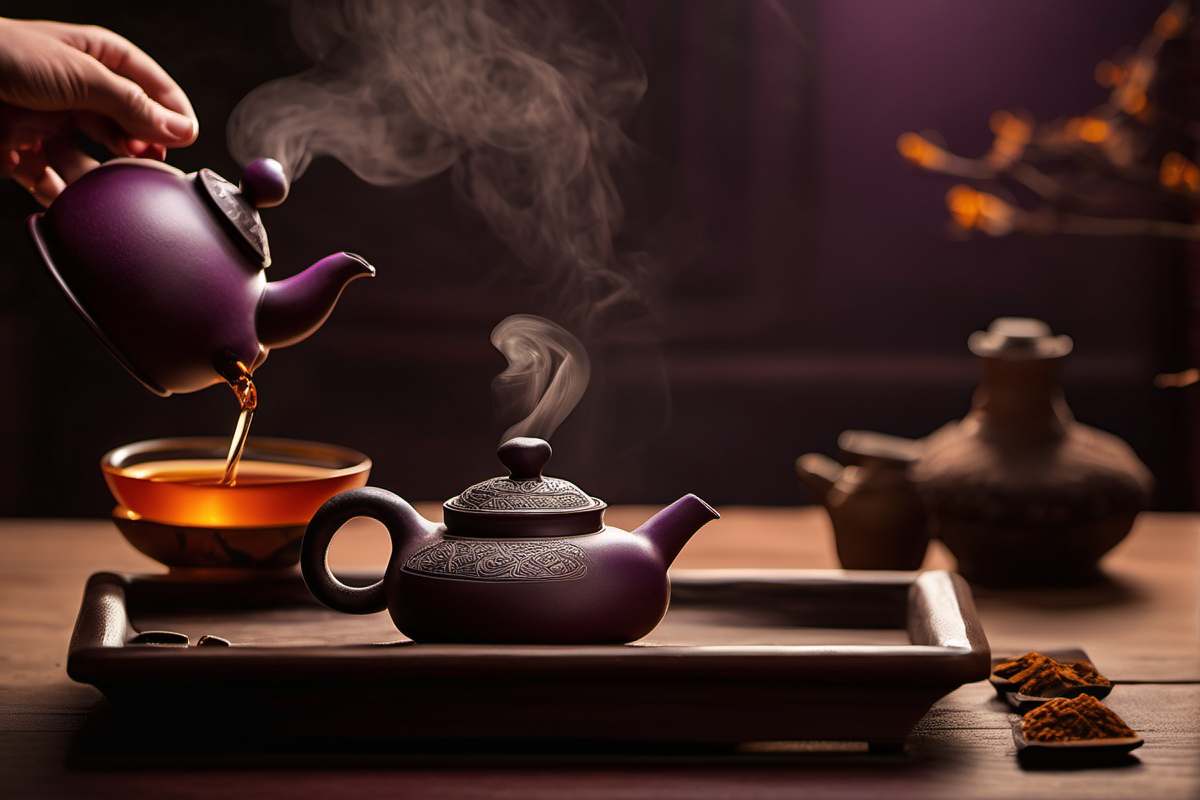
A Yixing teapot is not a teapot you buy. It is a teapot you keep.
After a few weeks of daily brewing, an authentic Yixing zisha (purple clay) pot begins to absorb oils from the tea leaves, slowly seasoning itself until the liquor it produces is rounder, sweeter, and more aromatic than the same tea brewed in porcelain. After years, the pot itself becomes a quiet record of what you drink — a Tieguanyin pot smells like Tieguanyin even when empty, a Da Hong Pao pot smells like Da Hong Pao.
This guide covers what Yixing teapots are, why Chinese tea drinkers have used them for over 500 years, which teas belong in them, how to season and care for a new pot, and how to tell authentic Yixing from the very convincing fakes. If you already own one, jump to the seasoning section; if you’re shopping, start at how to choose.
For a side-by-side of Yixing against the other gongfu vessels, see our Gaiwan vs Teapot guide.
The 30-Second Answer
- What it is: A small unglazed clay teapot (60–250 ml) made in Yixing, Jiangsu Province, from a special purple-sand clay (zisha)
- Best for: Wuyi rock oolongs (Da Hong Pao, Rou Gui, Shui Xian), Dan Cong oolongs, and aged pu-erh
- Not for: Green tea, white tea, yellow tea, or scented/flavored teas
- One pot = one tea type: never brew a Tieguanyin pot with Da Hong Pao
- Seasoning: 2–4 weeks of daily brewing with the same tea
- Price range: Authentic entry-level $30–60; collector pots $200–2000+
- Fakes: Common — most “Yixing” sold on Amazon, Etsy, and large online marketplaces is machine-pressed or non-Yixing clay. Buy from specialist teaware sellers (see sourcing)
Now let’s go deeper.
What Is a Yixing Teapot?
Yixing teapots (宜兴紫砂壶, yíxīng zǐshā hú) are small, unglazed clay teapots made in the city of Yixing in southern Jiangsu Province, China $TRAE_REF. They have been produced there for over 500 years, and the craft is considered a national intangible cultural heritage.
The clay itself is called zisha (紫砂, “purple sand”) — a unique iron-rich kaolin clay found in the Huanglongshan mountain range near Yixing $TRAE_REF. The clay comes in three natural color varieties:
| Clay type | Color | Best for | Notes |
|---|---|---|---|
| Zini (紫泥, “purple clay”) | Purple-brown | Most oolongs, aged pu-erh | The classic, most common, most versatile |
| Hongni (红泥, “red clay”) | Reddish-orange | High-roast oolongs | Slightly more porous; seasons faster |
| Duanni (段泥, “duan clay”) | Buff, sandy beige | Light oolongs, aged whites | Most porous; lighter teas to avoid flavor stain |
Benni (本泥, original clay) and Luni (绿泥, green clay) exist but are rarer and usually collector pieces.
Why Unglazed Clay Matters
The defining feature of a Yixing teapot is that it is unglazed — the clay itself is the brewing surface. This has two effects:
- Absorption — the porous clay slowly absorbs tea oils, building up a “seasoned” character over months and years
- Heat retention — the dense clay holds heat better than thin porcelain, producing a slightly more even extraction
The trade-off is that you cannot brew different teas in the same pot. Each pot becomes dedicated to one tea type — and within that tea type, ideally one specific tea (Tieguanyin pot for your Tieguanyin, Da Hong Pao pot for your Da Hong Pao, etc.). For more on this, see the one pot, one tea rule.
The Three Yixing Clays in Practice
A practical comparison:
| Trait | Zini | Hongni | Duanni |
|---|---|---|---|
| Color after firing | Purple-brown, deepens over time | Reddish-orange | Sandy buff |
| Porosity | Medium | Medium-high | Highest |
| Seasoning speed | 4–6 weeks | 3–5 weeks | 2–3 weeks (faster, more absorbent) |
| Best tea type | Most oolongs, aged pu-erh | High-roast oolongs, ripe pu-erh | Light oolongs, aged white, light sheng pu-erh |
| Aroma carry | Subtle | More pronounced | Most pronounced |
| Heat retention | Excellent | Excellent | Good |
For your first pot: zini is the most versatile and forgiving. Hongni is the choice if you drink mostly roasted Wuyi yan cha. Duanni is risky for beginners — it stains easily from dark teas and shows tea stains prominently on its light surface.
What Teas Belong in a Yixing Teapot
Yixing’s reputation comes from the synergy between porous clay and high-temperature, oxidation-heavy teas. The rule of thumb is heavier, roasted, oxidized teas benefit most:
Excellent pairings
- Wuyi rock oolongs (Da Hong Pao, Rou Gui, Shui Xian) — the classic pairing; rock mineral + clay mineral harmonize
- Heavy-roast Tieguanyin (传统工艺, traditional processing) — much better in clay than in porcelain
- Aged oolongs — clay smooths the aged character
- Ripe pu-erh (shou) — clay’s heat retention works well with the deep, soft character of shou
- Aged raw pu-erh (sheng, 5+ years) — clay softens the rough edges
Acceptable pairings
- Phoenix Dan Cong — works in Yixing, but porcelain is better for preserving the delicate fragrance (see our Dan Cong guide)
- Black tea (Zhengshan Xiaozhong, Dian Hong) — clay enhances the maltiness
Do not brew in Yixing
- Green tea — too cool, too delicate; clay overwhelms the freshness
- Yellow tea — same as green
- White tea — light, sweet, subtle; clay mutes it
- Scented or flavored teas — the absorbed flavor will haunt every future brew
- Multiple teas in one pot — the #1 way to ruin a Yixing
What a Yixing Teapot Does to Your Tea
Three things happen when you brew in unglazed Yixing clay that do not happen in porcelain or glass:
1. Softens high-temperature extraction
Clay holds heat more evenly than thin porcelain. This means the water inside the pot stays at brewing temperature longer, producing a more rounded, less sharp extraction. For teas that benefit from slow, even heat (rock oolongs, aged pu-erh), this is a major upgrade.
2. Absorbs and re-releases aroma compounds
Tea oils are slightly fatty and cling to the porous clay surface. Each brew deposits a thin layer; subsequent brews of the same tea pick up traces of the previous brews, deepening the character. After 2–3 weeks of daily use, your Tieguanyin pot makes Tieguanyin taste more like Tieguanyin.
3. Develops a patina
The exterior and interior of a well-used pot develop a soft sheen, slightly darker than the original clay, with a faintly waxy feel when dry. This patina is the visible sign of seasoning. Collectors prize old pots partly for the patina, which cannot be faked cheaply.
The trade-off for these three benefits: rigidity. Your Yixing pot is now a Tieguanyin pot. Don’t try to repurpose it.
The One Pot, One Tea Rule
This is the most important rule of Yixing teapot ownership. Once a pot has been seasoned with one tea, it will retain that tea’s character forever. Brewing a different tea in the same pot produces a confused, muddied cup — and once the muddiness is in the clay, you cannot remove it.
| If you mostly drink… | Buy a pot for… | Clay choice |
|---|---|---|
| Da Hong Pao, Rou Gui, Shui Xian | Wuyi rock oolong | Zini or hongni |
| Tieguanyin (heavy roast) | Anxi oolong | Zini |
| Ripe pu-erh | Ripe pu-erh | Zini |
| Multiple teas | One pot per tea | Zini (most versatile) |
If you are not yet sure which tea you’ll commit to, wait on buying a Yixing. Start with a porcelain gaiwan (see Gaiwan vs Teapot), explore a few teas, and buy a Yixing only when you find a tea you want to drink every day for the next several years.
How to Choose a Yixing Teapot
Choosing a Yixing teapot comes down to four decisions: clay, size, shape, and maker.
Size
Match the pot to your usual brewing session:
| Pot size | Best for |
|---|---|
| 60–90 ml | Solo gongfu, 1–2 steeps at a time |
| 100–150 ml | One-person daily ritual, 2–4 steeps |
| 150–200 ml | Two-person sessions, sharing with a partner |
| 200–250 ml | Small group, 3–4 people |
For most gongfu drinkers, 100–150 ml is the sweet spot. Smaller than 60 ml and you’re constantly re-brewing; larger than 200 ml and the pot becomes awkward for one person.
Shape
Traditional Yixing shapes each suit a tea slightly differently:
| Shape | Best for | Notes |
|---|---|---|
| Xishi (西施, “Beauty”) | Daily brewing, all-around | Most popular, balanced, easy to pour |
| Shipiao (石瓢, “Stone Ladle”) | Rock oolongs | The classic scholar’s pot; great for Wuyi yan cha |
| Zhuni (珠泥) small pots | Most oolongs | Good for solo drinking |
| Dezhong (德钟) | Wuyi yan cha | Tall, classic, refined pour |
| Shui Ping (水平, “Level”) | All-purpose | Stable, balanced, beginner-friendly |
| Long Dan (龙蛋, “Dragon Egg”) | Most oolongs | Egg-shaped, holds heat well |
| Fang Gu (方鼓, “Square Drum”) | Display + brewing | Square shape, harder to make, more decorative |
For your first pot: Xishi or Shui Ping in zini, 100–150 ml. These are the most forgiving shapes, most common, and easiest to find authentic.
Half-handmade vs fully handmade
This is the most important authenticity question. Yixing teapots come in three construction methods:
- Fully handmade (全手工) — built by hand without molds. Each piece is unique, the inside seams show knife marks, and the price reflects the labor. This is the authentic Yixing experience.
- Half-handmade (半手工) — the body is slip-cast or mold-formed, the handle and spout are hand-attached. Common in the $40–100 range. Decent quality, less collectible.
- Fully machine-made — produced industrially. The cheapest, the most common on Amazon and large marketplaces. The pot works, but it is not a Yixing in the traditional sense.
For a first pot: a half-handmade or fully handmade zini pot in the $30–80 range is realistic. Below $25 is almost certainly machine-made or non-Yixing clay, even if labeled “Yixing.”
Maker
Yixing teapots are signed by their maker. The signature (印章, yinzhang) is on the bottom or handle. Famous modern masters can command $1000–100,000+ per pot, but for everyday use, an unsigned or junior-potter half-handmade pot is perfectly fine. Look for:
- Clear seams inside the pot
- A spout that pours cleanly without dribbling
- A lid that fits with a precise, almost frictionless “click” when rotated
- A handle comfortable to hold
- Clay color consistent with stated type
If the price seems too good to be true, it is.
Seasoning Your New Yixing Teapot
A new Yixing pot needs seasoning before it produces its best tea. The goal is to fill the clay’s pores with the tea you intend to brew in it.
Step-by-step seasoning
- Inspect the pot — open the lid, look inside for dust or clay fragments. Rinse the outside with warm water; do not use soap.
- First brew is a discard — brew your intended tea at full strength (same leaf amount as you would normally use), steep 30–60 seconds, pour out. This “opens” the clay.
- Rinse with warm water only — no soap, no detergent, ever. The clay’s pores will absorb whatever you put in them.
- Daily brews for 2–4 weeks — use the pot daily for the same tea. Each brew adds a thin layer of seasoning.
- Dry with lid off — between uses, let the pot air-dry completely with the lid off. Trapped moisture causes mold or off-flavors.
- Avoid — boiling water baths, lemon, vinegar, baking soda, dishwasher, microwave. All will damage the clay.
You will notice a difference after 2–3 weeks: the liquor tastes slightly softer, and the pot begins to feel faintly waxy on the outside when dry. After 6–12 months, the patina is fully developed.
Quick seasoning alternative
If you cannot wait 4 weeks, you can accelerate by:
- Brewing 2–3 times a day in the first week (instead of once)
- Using slightly more leaf than usual for stronger seasoning
- Doing a 30-minute long steep once a week (discarded)
But genuine seasoning still takes time. A year of steady use produces a far better pot than a month of forcing.
Daily Use and Care
During a session
- Pre-warm with hot water before adding leaves
- Use a tea pitcher (gongdao bei) to pour brewed tea, then distribute to cups — never pour from the pot directly over cups, especially with thick-walled Yixing
- Empty the pot completely after each session — never let brewed tea sit in the pot for hours
After a session
- Rinse inside and out with warm water only
- Wipe dry with a soft cloth
- Leave the lid off to air-dry for 6–12 hours before storing
Long-term storage
- Store in a dry, ventilated place with the lid off
- Avoid airtight containers (trapped moisture)
- Keep away from other pots if they are dedicated to different teas — odors can transfer slowly
- Avoid direct sunlight, which fades clay color
What ruins a Yixing pot
- Soap or detergent — absorbed forever, ruins every future brew
- Dishwasher — heat and detergent both damage clay
- Baking soda or vinegar — sometimes recommended online; both penetrate and alter clay
- Boiling the empty pot — can crack thin sections
- Storing with the lid sealed while damp — mold inside
- Switching teas — see one pot, one tea
Common Questions
Are Yixing Teapots Worth It?
For a dedicated daily drinker of Wuyi oolong, ripe pu-erh, or aged oolong — yes. A $40–80 half-handmade zini pot produces measurably better tea than a porcelain gaiwan after a few months of seasoning, and it will last decades.
For a casual drinker, a beginner, or anyone who wants flexibility — not yet. Get a porcelain gaiwan first, drink 5+ different teas, and only invest in Yixing when you know which tea you’ll commit to.
Why Are Some Yixing Teapots So Expensive?
Three reasons drive the high end:
- Fully handmade labor — a master potter spends 1–3 days per pot, hand-shaping every curve
- Named masters — some modern masters are nationally recognized; their pots command $1000–100,000+ at auction
- Old clay (老泥) — clay that has been aged in storage for decades is more plastic, more consistent, and produces a more refined pot
For everyday brewing, a $40–80 half-handmade zini pot is 90% of the experience at 5% of the price.
How Can I Tell If My Yixing Is Real?
Authenticity tests (use together, not in isolation):
- The lid test — a real Yixing lid fits with a precise, almost-zero-clearance fit. Fakes tend to wobble or sit loosely.
- The pour test — real Yixing pots pour cleanly without dribbling from the spout after you stop pouring. Cheap pots dribble.
- The inside seams — open the lid and look inside. Handmade pots show visible hand-trim marks. Machine-made fakes have smooth, often irregular inside surfaces.
- The smell test — new Yixing has a faint, dry, mineral smell. Fakes may smell of plastic, paint, or nothing.
- The price test — anything under $20 claiming to be handmade Yixing is almost certainly fake.
- The seller test — buy from a specialist teaware seller (Yunnan Sourcing, Crimson Lotus Tea, Jing Tea Shop, Tea Drunk, or a Chinese teaware specialist). Avoid Amazon, Etsy mass sellers, and unknown eBay sellers.
Can I Use a Yixing Teapot for Green Tea?
No. Green tea is too delicate and too low-temperature for Yixing. The clay will overwhelm the fresh, vegetal character and slowly absorb compounds that will haunt every future brew. Use a porcelain gaiwan or glass teapot for green tea.
How Long Does a Yixing Teapot Last?
Generations, with care. A well-made Yixing pot used and cleaned properly can outlive its owner. The clay is durable; the only real risks are cracking from impact, damage from soap/chemicals, and the slow “ruin” from switching tea types.
What If My Teapot Dribbles From the Spout?
Three common causes:
- The spout is too high or too low relative to the pot’s rim — a maker’s flaw, less common in handmade pots
- The hole inside the spout is partially blocked by leaf or mineral buildup — clean with a thin bamboo or bamboo-style pick
- You filled the pot above the air-pressure limit — leave a small air gap; filling 80% max usually solves this
If the spout is structurally wrong, the pot will dribble regardless of fill level. This is a maker’s flaw and not user-fixable.
Should I Buy a Yixing Teapot or a Gaiwan First?
A gaiwan first. A 100 ml porcelain gaiwan costs $10–25, brews any tea, and teaches you what the tea itself tastes like without clay interference. Once you know which tea you want to commit to daily, then invest in a Yixing.
See our Gaiwan vs Teapot guide for the full comparison.
Can I Brew Multiple Teas in a Yixing Teapot If I Rinse Well?
No. Rinsing with water does not remove absorbed compounds from porous clay. The tea you brewed yesterday will be present, faintly, in today’s brew. The only way to “switch” a Yixing pot is to dedicate it to a single tea forever.
If you want to switch a pot to a new tea, the only practical option is to buy a new pot for the new tea.
Where to Buy
Authentic Yixing is mostly sold through specialist tea and teaware vendors, not general marketplaces.
Trusted online sources (as of 2026):
– Yunnan Sourcing (US-based, ships worldwide) — large selection, well-documented
– Crimson Lotus Tea (US-based) — small-batch, high-quality
– Jing Tea Shop (US-based) — beginner-friendly selection
– Tea Drunk (US-based) — curated, master-level
– Mei Leaf (UK-based) — detailed video reviews, deep stock
– Chinese teaware specialist sellers on Taobao (for those with a Chinese shipping address)
Avoid: Amazon, Etsy mass sellers, eBay unknown sellers, large Chinese exporters on Alibaba. The market is flooded with non-Yixing clay or machine-pressed pots labeled “Yixing.”
Further Reading
- Gaiwan vs Teapot: Which Should You Buy First? — the vessel decision
- How to Brew Da Hong Pao — the classic Wuyi yan cha pairing
- How to Brew Rou Gui — the cinnamon rock oolong
- How to Brew Tieguanyin — Anxi oolong
- How to Brew Phoenix Dan Cong — Guangdong oolong
- How to Choose Your First Gaiwan — the gateway vessel
- How to Store Chinese Tea — keeping your teas fresh
- Chinese Tea Glossary — 20+ terms defined
1 thought on “Yixing Teapots: The Complete Guide for Chinese Tea Drinkers”