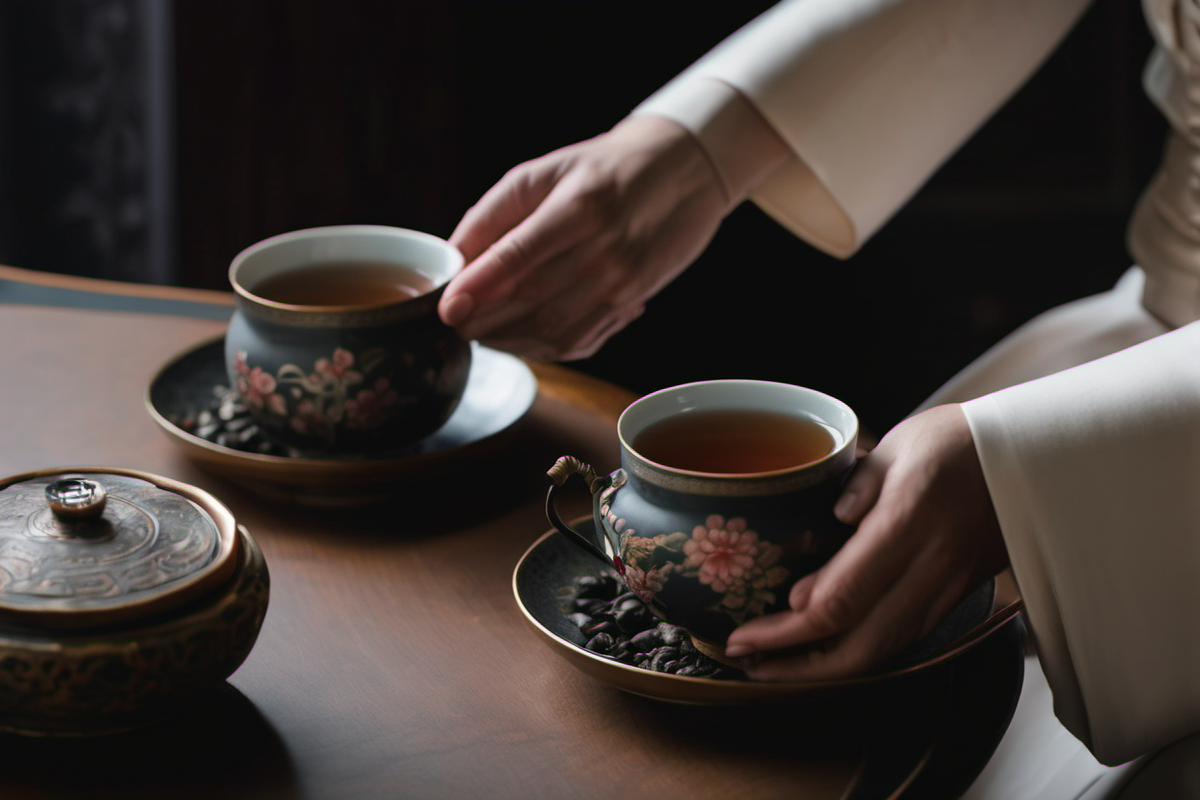
Chinese tea ceremony etiquette is less about rigid formality than about showing respect, attention, and care. Most rules come from practical considerations (don’t burn your guests, don’t drip tea on the table) refined over centuries of practice into gestures that feel natural once you know them.
This guide covers everything a host or guest needs to know: the most important etiquette rules, the meaning behind common gestures, what to do when you’re at someone else’s tea table, and how to host a tea session gracefully without stress.
If you’re new to tea itself, see our complete brewing guide first. For the broader tradition, see our gongfu tea ceremony walkthrough.
The 30-Second Answer
The five rules that matter most:
- Pour tea for others before yourself. As host, you serve; as guest, you wait to be served.
- Fill cups to 70%, not full. “Seven parts tea, three parts affection” — full cups burn fingers and look greedy.
- Receive and serve with both hands. Right hand holds, left hand supports. Never touch the rim.
- Tap two fingers on the table to say thank you. This is the most recognized Chinese tea gesture — index and middle finger of your right hand, tap twice on the table or cup base.
- The order of service: elders first, then guests, then hosts; women before men. Within a group, serve in order of seniority.
Everything else is detail and tradition. These five rules will get you through 95% of tea situations gracefully.
A Note on Formality
Chinese tea etiquette has layers:
- Everyday informal: with family or close friends, almost any etiquette is fine — pouring yourself first is normal
- Semi-formal: with guests or business associates, the five rules above apply
- Formal: traditional gongfu ceremony with multiple guests, requires more attention to detail
If you’re a beginner, aim for the semi-formal version. The formal etiquette is a deep art and not necessary for daily practice.
For Hosts: How to Serve Tea Properly
1. Prepare Before Your Guests Arrive
- Clean the teaware — rinse with hot water; warm the vessels
- Have enough tea — bring out enough leaves for the session; don’t ration
- Pre-heat the cups — pour hot water into cups, swirl, discard before brewing
- Set the water — boiled and cooled to the right temperature for the tea you’ll brew
These steps show that you’re ready, organized, and care about the experience. Doing them while guests watch is also fine — it shows the process.
2. The Order of Service
When pouring for multiple guests, follow this order:
- Elders first — oldest or most senior
- Guests before host — you serve, you drink last
- Women before men — in mixed groups, generally (though this is less rigid in modern contexts)
- Most important guests first — if there’s a “guest of honor” or someone you’re particularly hosting
The logic is the same as Chinese banquet etiquette: respect hierarchy, then host your guests generously.
If you’re at the table and someone else is doing the pouring (the si lu, 司炉 or tea master), they’re served last. This is a small but consistent rule.
3. The Seven-Tenths Rule
Fill each cup to roughly 70% full, not to the rim. This is one of the most consistent rules across all Chinese tea situations.
| Fill level | Meaning |
|---|---|
| Under 50% | Insulting — implies you don’t value the guest |
| 50–70% | Acceptable but low |
| 70–80% | Standard — polite and practical |
| 80–90% | Generous but risky (easy to spill) |
| Over 90% | Rude — looks careless and is hard to drink from |
Why 70%? The original Chinese expression is “七分茶,三分情” — “seven parts tea, three parts affection.” This rule combines practical and symbolic meanings:
- Practical: a half-full cup is easier to hold without burning your fingers on the rim
- Symbolic: leaving room shows generosity and thoughtfulness, not greed
In casual settings with close friends, the rule relaxes — you can fill higher when pouring for people you know well. With new guests or formal situations, hold to 70%.
4. Use Both Hands
When serving tea to a guest: hold the cup with both hands — right hand grips the cup, left hand supports the bottom or the wrist of the right hand. Never touch the rim or inside of the cup with your fingers.
This is partly hygiene (your fingers don’t touch where the guest will drink) and partly respect (showing the cup with care).
When handing teaware (a teapot, gaiwan, pitcher): pass with both hands, or with the right hand and left hand supporting. Always orient the spout or pour direction away from the recipient — pointing a teapot spout at someone is a small faux pas.
5. Mind the Spout Direction
When you set the teapot or gaiwan down between pours, point the spout (or pouring direction) away from people — not directly at anyone. Pointing a teapot spout at someone is considered unlucky or rude, similar to pointing chopsticks upright in a bowl of rice.
The spout should point toward an empty area of the table, ideally toward the host (you) rather than any guest.
6. Re-Fill Before Empty
When you notice a guest’s cup is getting low, refill it without being asked. Topping up is part of the host’s continuous care — letting someone’s cup sit empty suggests you’re not paying attention.
If the guest clearly doesn’t want more, they’ll cover the cup with their hand or tilt it slightly — see the guest section below.
7. Pace the Session
- Don’t rush the brewing — let the water cool to the right temperature; pour at the right speed
- Don’t over-serve — at gongfu sessions, the same tea steeps many times; pace the refills
- Don’t force more tea on guests who’ve had enough — water or a short break is fine
- Watch the conversation — pour when there’s a natural pause, not in the middle of someone’s story
The best hosts make tea service feel almost invisible — the cup stays full, the conversation flows, no one is waiting.
For Guests: How to Receive and Drink
1. Wait to Be Served
Don’t pour your own tea before others are served. At a tea table with multiple people, especially with elders or hosts present, pouring yourself first is presumptuous.
If the host is slow or distracted, you can pour for the person next to you in seniority order — a graceful gesture.
2. Receive with Both Hands
When the host hands you a cup of tea, accept with both hands — right hand holds the cup, left hand supports the bottom or your right wrist. This mirrors how the host serves you and acknowledges the gift.
For a small cup you can use just the right hand and place the left hand under your right elbow or wrist. The principle: support the cup with two hands whenever practical.
3. The Finger Tap (叩指礼) — The Thank You Gesture
When the host pours tea for you (especially if they’re pouring for many guests and can’t hand the cup to you directly), tap two fingers on the table as your silent thank you.
How to do it:
– Use your right hand
– Extend your index finger and middle finger together
– Tap two or three times lightly on the table (or on the cup base)
– The tap represents bowing with both hands — a kneeling bow
Why? The story goes that Emperor Qianlong, traveling in disguise, once poured tea for a servant. The servant couldn’t kowtow (the formal bow) without revealing the emperor’s identity. So he bent his finger into a “bow” on the table. The finger-tap has been the standard thank-you gesture in Chinese tea culture ever since.
When to use it: any time someone pours tea for you, especially in a semi-formal setting. You don’t need to use it for every refill at a casual home setting, but it’s always appropriate.
4. Sip Before Complimenting
Taste before you comment. When served a new tea, take a small sip, let the flavor settle, and only then comment. This shows you’re paying attention rather than reflexively praising.
If the tea is exceptional, a simple nod, smile, or “very good” (in Mandarin: 很好喝, hěn hǎo hē) is appropriate. Detailed tasting notes are welcome but not required.
5. How to Hold the Cup
- Small cups (30–60 ml): hold with thumb and index finger, support with middle finger. Use both hands for the first sip.
- Medium cups (100–150 ml): same grip, but more comfortable to cradle with both hands.
- Large cups (200+ ml): usually use one hand.
Avoid:
– Wrapping both hands fully around a small cup (looks awkward and blocks your face)
– Tilting the cup so the bottom points at someone (rude)
– Blowing on the tea to cool it (acceptable for yourself, not for showing off)
6. Saying “I Have Enough”
When you want to slow down or stop drinking:
- Cover the cup with your hand (right hand, palm down, gently on top) — universal signal
- Tilt the cup slightly so it’s clear you’re not about to drink
- Say “够了” (gòu le, “enough”) politely
The host will understand and stop refilling you.
7. Don’t Comment on Price or Quality
At a tea table hosted by someone else:
- Avoid asking how much the tea costs — can feel transactional
- Avoid saying “this is bad” — even if true, the host chose it
- Accept what you’re given graciously
- Compliment the host’s hospitality rather than the tea itself, unless it’s exceptional
If you have a question about the tea, ask about origin, harvest, or processing — these show genuine interest without implying price judgments.
Common Gestures and Their Meanings
| Gesture | Meaning |
|---|---|
| Two-finger tap on table | Thank you (for pouring tea) |
| Cover cup with hand | I’ve had enough |
| Pour for others first | Respect/hospitality |
| Both hands when receiving | Respect |
| Spout pointing at someone | Taboo — looks aggressive or unlucky |
| Touching the cup rim with fingers | Hygiene violation |
| Standing while host sits | Awkward — usually everyone sits together |
| Loud slurping | Common in Japanese tea, less so in Chinese — sip quietly |
Practical Scenarios
Hosting a First-Time Tea Friend
If someone has never been to a Chinese tea session:
- Explain the basics briefly before pouring — “tap two fingers on the table when I pour, and feel free to put your hand over the cup when you’ve had enough”
- Don’t over-formalize — keep it relaxed
- Pick an easy-to-brew tea — Tieguanyin or green tea, not aged pu-erh
- Have water available for them to switch if caffeine or strong flavors are an issue
- Ask what they like — if they don’t know, suggest a light oolong or green tea
Being a Guest at Someone Else’s Tea Table
- Mirror the host’s pace — if they brew fast, drink fast; if they brew slow, sip slowly
- Compliment the tea if you enjoyed it, in plain terms
- Ask questions about origin or processing — these are appreciated and show interest
- Don’t take over the brewing unless explicitly invited — even if you’re more experienced
Hosting in a Restaurant
If you’re at a restaurant with tea service:
- The staff pours and refills — accept graciously
- Tap the table or cup to thank them
- If pouring yourself at a multi-person table, follow the order rules above
Hosting Multiple Guests of Different Backgrounds
- Brief anyone unfamiliar with the finger-tap before pouring
- Don’t force etiquette — if a guest is uncomfortable, just brew and serve
- Pour for others first — this is the universal rule that works in any context
Common Etiquette Mistakes to Avoid
Pouring for Yourself First
The most common Western mistake. At any group tea session, wait to be served or serve others before yourself. If you pour your own, you signal you’re above the group in some way.
Touching the Rim or Inside of the Cup
Hygiene and respect both. Always hold cups from the outside, with the right hand (and left support).
Filling Cups to the Brim
Looks careless and makes the cup hard to drink from. Aim for 70%.
Leaving a Spout Pointed at Someone
A small but real taboo. Keep the spout pointed at neutral space.
Loudly Slurping
Less accepted in Chinese tea than in Japanese. Sip quietly.
Complaining About the Tea
Even subtle disappointment comments are bad form at someone else’s table. Save detailed critique for private settings.
Using Your Phone While Pouring
Disrespectful to the tea, the guests, and the moment. Set the phone aside.
Refusing Tea Repeatedly
If a host offers tea and you decline three times, it can come across as rude. Accept once, drink politely, and then you’re free to slow down with the hand-cover signal.
Etiquette in Different Tea Settings
Home Tea Session
Most relaxed. Etiquette softens — pouring yourself first is fine with close friends; the seven-tenths rule relaxes; the finger-tap is appreciated but not required.
Tea Shop or Tea House
More formal. The staff may demonstrate specific rituals. As a customer, follow their lead; if you’re with experienced tea drinkers, observe and adapt.
Business Setting
Most formal. Treat it like a meal with clients — observe the host’s cues, use the finger-tap, pour for others, accept graciously. A senior person’s tea preferences and pouring style may set the tone.
Public Tea Events or Competitions
Ceremonial. Don’t try to inject your own etiquette — observe and follow what others do.
The Spirit Behind the Rules
Most etiquette rules in Chinese tea come from a few underlying principles:
- Hospitality — tea is shared; the host’s role is to ensure everyone is comfortable and has tea
- Modesty — filling cups to 70%, serving others first, accepting with both hands all signal that you don’t take the tea (or yourself) too seriously
- Attention — watching the cup, refilling before empty, pacing the session shows you’re caring for everyone, not just brewing
- Hierarchy respect — elders first, hosts last, women before men in mixed groups all reflect a cultural comfort with status that Western tea culture often ignores
If you remember those principles, you can adapt to almost any tea situation — even one where you don’t know the specific rule.
FAQ
Why do Chinese people tap two fingers when receiving tea?
The two-finger tap represents a bow or kowtow. It dates back to Emperor Qianlong, who poured tea for a disguised companion; the companion “bowed” with his fingers instead of his body to avoid revealing the emperor’s identity. The gesture stuck and is now the standard silent thank-you in Chinese tea culture.
Why do Chinese people fill cups only 70%?
The saying is “七分茶,三分情” — seven parts tea, three parts affection. Filling to 70% prevents the guest from burning their fingers on the rim and looks generous rather than greedy. Full cups also spill easily during drinking.
Is it rude to pour my own tea?
In semi-formal or formal settings with multiple people, yes — pouring yourself first signals you’re above the group. In casual home settings with close friends, it’s fine. If you find yourself wanting to pour and no one else is doing it, pour for the person next to you first.
What if I don’t like the tea I’m served?
Accept it gracefully. Drink at least a sip, don’t comment negatively, and quietly cover your cup with your hand when you’ve had enough. If you’re hosting yourself, choose a tea you think your guests will enjoy, and have water available.
Is it rude to add sugar or milk to Chinese tea?
Generally, yes — adding anything to Chinese tea changes the character in ways most Chinese tea drinkers don’t expect. If you’re at a Western tea shop or hotel where customizations are offered, it’s fine. At a traditional Chinese tea session, drink it as served.
Why are there so many rules?
Most etiquette rules come from practical experience: don’t overfill (burns fingers), don’t touch the rim (hygiene), don’t pour your own (signals status). Once you understand the practical reason, the rules feel natural rather than arbitrary.
Can I bring my own tea to a session?
It’s acceptable if you bring something to share, especially a special tea you want to show off. But don’t bring your own and only drink your own — that’s antisocial. If you bring tea, brew it for the group.
What’s the difference between Chinese and Japanese tea etiquette?
- Japanese tea ceremony (chanoyu) is highly formalized, with specific movements and meanings — more like a ritual
- Chinese tea ceremony (gongfu cha) is more flexible and conversational — emphasis on the tea itself rather than choreographed movement
- The finger-tap is uniquely Chinese; bowing is more Japanese
- Loud slurping is appreciated in Japanese tea; sips are quiet in Chinese
What if I make a mistake?
Don’t apologize excessively — a quick “sorry, I’m still learning” is fine. Most Chinese tea drinkers will appreciate that you’re trying. The bigger faux pas is making a big deal of mistakes rather than just adjusting.
Is the etiquette the same across all Chinese tea regions?
Mostly yes, with regional variations. In Taiwan, the gongfu style is very similar. In Hong Kong tea restaurant culture, the etiquette is more relaxed but the finger-tap and two-hand receiving are universal. In mainland China, formality varies by city and setting. The principles above are widely accepted.
Further Reading
- How to Brew Chinese Tea (Complete Guide) — the foundational method
- Gongfu Tea Ceremony: Step-by-Step — the deeper tradition
- How to Use a Gaiwan — the most common brewing vessel
- How to Choose Your First Gaiwan — buying teaware
- Essential Teaware for Gongfu Tea — the full starter kit
- Best Chinese Tea for Beginners — what to brew first
Categories: Brewing, Buying & Storage