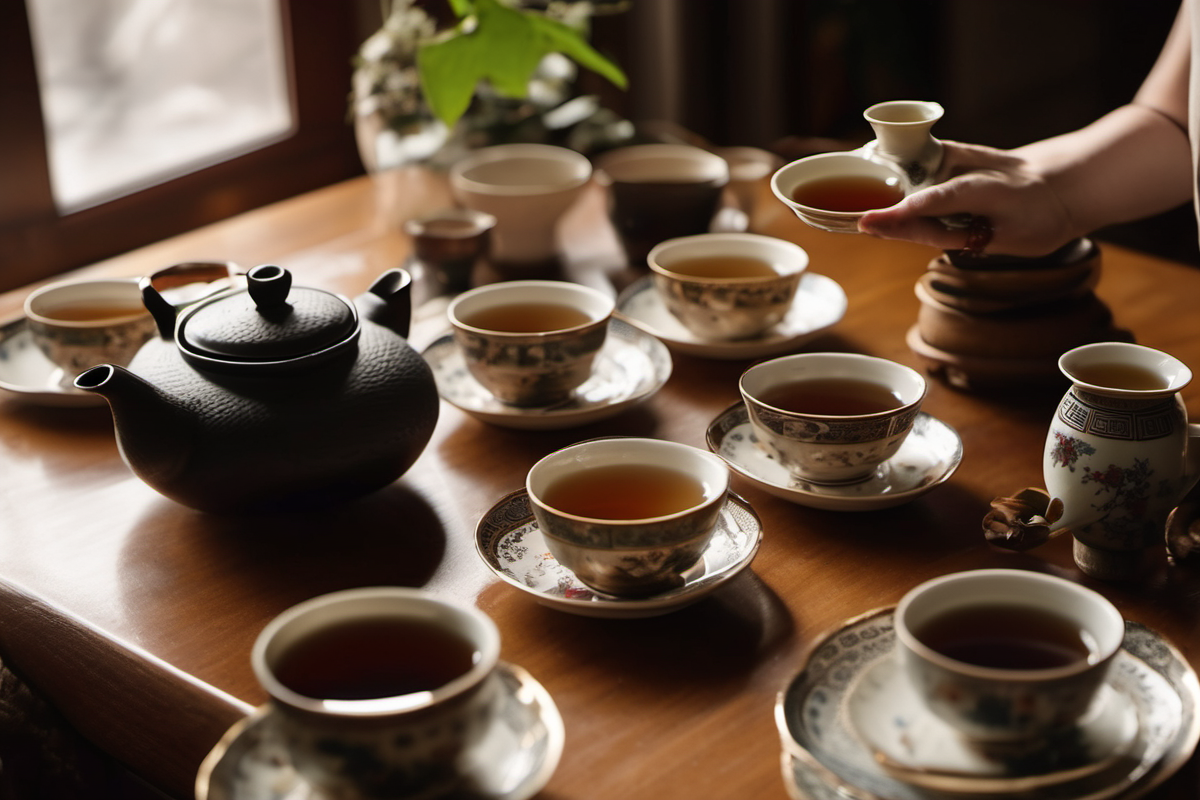
Hosting a small gongfu tea tasting at home is one of the most rewarding ways to share Chinese tea with friends. It doesn’t require special training, expensive equipment, or formal ceremony — just a clear plan, two or three good teas, and the willingness to learn alongside your guests.
This guide gives you a complete playbook for your first tasting: what to buy, how to set up your table, what teas to brew and in what order, what to say (and not say), and how to handle common awkward moments without breaking the flow.
If you’re new to gongfu brewing itself, start with our complete brewing guide and our essential teaware list. For etiquette during the session, see our ceremony etiquette guide.
The 30-Second Answer
Your first gongfu tea tasting needs just three things:
- Two or three teas with a clear progression — start light (green or white), end deep (roasted oolong or ripe pu-erh)
- One 100–150 ml gaiwan per tea plus a fairness pitcher, small cups for everyone, and a kettle
- A loose plan — order of teas, rough timing, a few talking points — and the willingness to adjust as you go
That’s it. The mistake most first-time hosts make is over-preparing. Your guests don’t need a perfect ceremony; they need to taste good tea and have a relaxed time.
Who to Invite
Ideal First Group
- 2–4 people is the sweet spot for a first tasting
- One or two curious friends is better than a big group of indifferent guests
- Pick people who are open to new experiences — not necessarily tea experts
- Mix tea experience levels if possible — having one person who’s tried a few teas makes the conversation easier
Who to Skip for Round One
- Anyone who “doesn’t really drink tea” — they’re not the audience yet
- Very large groups (6+) — logistically harder, harder to keep everyone engaged
- People who’ll dominate the conversation with strong opinions on tea — they pull focus from the actual tasting
A first tasting is best as a small, casual gathering of curious people, not a formal event.
When to Host
- Weekend afternoon (2–5 pm) is the traditional Chinese tea tasting window — long enough to taste multiple teas, but not so late that caffeine keeps everyone up
- Avoid right after meals — heavy food dulls the palate
- Avoid right before meals — caffeine on an empty stomach can be unpleasant for sensitive guests
- Allow 2 hours minimum — one tea takes 30–45 minutes to taste through several infusions
If you’re hosting on a weekday evening, finish by 7 pm so caffeine-sensitive guests can still sleep. Stick to white and light oolong after 5 pm — skip black tea and pu-erh.
What Teas to Buy
For your first tasting, three teas is the magic number. Two is fine if you’re pressed for time or budget; four is overkill for a beginner session.
The Recommended Progression
| Order | Tea type | Why this position | Example |
|---|---|---|---|
| 1st | Light, easy to love | Welcome guests with something they’ll enjoy | Tieguanyin (modern green-fresh) or Longjing |
| 2nd | Medium complexity | Bridge between familiar and bold | White Peony or Dong Ding oolong |
| 3rd | Deep, distinctive | End with a memorable “wow” tea | Da Hong Pao or Ripe pu-erh |
This progression goes from light and aromatic to deep and complex. Each tea “earns its place” by contrast with the previous one.
If You Have Time and Budget for One More
A fourth tea lets you show aging. After the three above, finish with:
- An aged raw pu-erh (5–10 years), or
- An aged Tieguanyin (nong xiang, heavily roasted style)
Aging changes the same fundamental tea dramatically, and tasting the difference side-by-side is the most dramatic “aha” moment you can create.
How Much Tea to Buy
For 3–4 guests tasting 3 teas gongfu-style:
- Each tea: 15–20 g is enough for 3 sessions of 5–7 infusions
- Total: 50–60 g across all three teas
That’s roughly $15–25 per tea at mid-range quality.
If you want to be generous, double the amounts so guests can take home some of the dry leaf. It’s a lovely gesture and costs you under $50 total.
What Teaware You Need
You don’t need much. Here’s the minimum setup.
Required
| Item | Quantity | Purpose | Budget |
|---|---|---|---|
| 100–150 ml porcelain gaiwan | 1 | Brewing vessel | $15–25 |
| Fairness pitcher (gong dao bei, 公道杯) | 1 | Evenly distributes each infusion | $10–20 |
| Small tasting cups | 4–6 (one per guest + 2 spare) | Drinking vessel | $10–20 for a set |
| Tea tray (chaban, 茶盘) | 1 | Catches spills | $20–50, or use a kitchen tray |
| Kettle with temperature control | 1 | Heat water to specific temperatures | $40–80, or boil and cool manually |
| Scale (0.1 g precision) | 1 | Measure leaf accurately | $10–15 |
Nice to Have
| Item | Purpose |
|---|---|
| Multiple gaiwans (one per tea) | Avoids flavor cross-contamination when switching teas |
| Tea pets (茶宠) | Small clay figures that “drink” the spilled tea — adds atmosphere |
| Tasting cups with white interior | Lets you judge liquor color accurately |
| A second kettle or thermos | Keeps hot water ready between teas |
| Towel (chabu, 茶布) | Wipes the gaiwan rim between pours; visually signals brewing |
What You Don’t Need
- A tea master or expert
- An expensive tea set
- A tea house-quality tea tray
- Multiple Yixing pots
- Anything labeled “ceremonial”
A plain white porcelain gaiwan and small cups work as well as anything more elaborate.
For full teaware guidance, see our essential teaware for gongfu tea guide and our how to choose your first gaiwan guide.
Setting Up the Table
Physical Layout
- Sit in a circle or around a square so everyone can see each other and the brewing
- The host sits closest to the kettle and gaiwan — natural brewing position
- Each guest has a cup within easy reach, ideally a saucer underneath
- The fairness pitcher sits between host and guests so pouring is visible
- Leave space for the tea tray, leaves, and any extras
Lighting and Atmosphere
- Natural light is best — pour color shows most accurately
- Quiet background music (optional, low volume) sets a relaxed mood
- No phones on the table — keep them in pockets or another room
- Avoid strong smells nearby — cooking food, perfume, candles can compete with the tea aromas
Pre-Heat Everything
Before guests arrive:
- Rinse all teaware with hot water to remove any storage smell
- Pre-heat the cups by pouring hot water in and out
- Pre-heat the gaiwan and pitcher the same way
- Have the first kettle of water at temperature for the first tea
This is “warming the teaware” — a real gongfu step that also has practical purpose: cold porcelain affects the first infusion’s temperature.
The Tasting Itself
The Opening (5 minutes)
Before you brew, introduce the tasting:
- “We’re going to try three teas today — a light oolong, a white tea, and a roasted oolong. We’ll taste each one across several short infusions.”
- Mention any constraints: “We have about 90 minutes total” or “We can stay as long as people want.”
- Set the etiquette briefly: “When I pour for you, tap two fingers on the table to say thanks. Cover your cup with your hand if you’ve had enough.”
- Invite questions: “Stop me anytime if you have questions.”
This takes 1–2 minutes but sets the tone for the whole tasting.
For Each Tea (20–30 minutes)
For each tea, follow a consistent flow:
- Show the dry leaf — pass it around in the lid or a small dish; let guests feel and smell
- Brief origin note — one or two sentences about where it’s from and how it’s processed
- Measure and add leaves — show the amount (8 g per 150 ml is standard); explain the ratio
- Warm the leaves — pour hot water, swirl gently, discard (this is the rinse, “awakening”)
- First infusion — pour, distribute to cups via the pitcher, let guests smell before drinking
- First tasting — sip, let the flavor sit, discuss: “What do you notice? Aroma? Body? Sweetness?”
- Subsequent infusions — repeat with shorter or longer steeps depending on the tea
- Brewing discussion — mention water temperature, why you chose this tea, common variations
- Closing the tea — when flavor fades, briefly mention: “We’ve reached the end of this one — about 8 infusions, which is normal for this grade.”
Between Teas (3–5 minutes)
Between teas, take a short break:
- Refill water in the kettle
- Empty cups and rinse the gaiwan (or switch to a fresh one)
- Offer water to guests — clears the palate between teas
- Open discussion about the previous tea: “What stood out to you about that one?” Don’t demand answers; let conversation flow
Pacing
| Phase | Time |
|---|---|
| Welcome + intro | 5 min |
| First tea | 20–30 min |
| Between-tea break | 3–5 min |
| Second tea | 20–30 min |
| Between-tea break | 3–5 min |
| Third tea | 20–30 min |
| Wrap-up + chat | 10–15 min |
| Total | ~2 hours |
Don’t rush. Each tea deserves 5–8 infusions to be appreciated.
What to Say (and Not Say)
What to Say
- “Try smelling first, then sipping” — directs attention to aroma, often the most striking part
- “What stands out to you?” — invites observation without leading the answer
- “It’s okay if you don’t like this one” — removes pressure, opens honest conversation
- “This one’s famous for X flavor” — context that helps guests notice what you noticed
- “Let me know when you’ve had enough” — gives permission to slow down
- “Want to try brewing the next one yourself?” — invites participation from curious guests
What Not to Say
- “This is supposed to taste like orchid” — leading the answer kills independent observation
- “Real tea drinkers prefer Y” — gatekeeping; everyone’s palate is valid
- “This tea was $X per gram” — price talk makes tea feel transactional
- “You’re supposed to hold the cup with both hands” — over-formalization for casual guests
- “You probably need to acquire the taste” — dismissive of genuine reactions
- Long technical explanations about oxidation, processing, terroir — share if asked, but don’t lecture
The best hosts make the tea the star, not themselves.
What to Brew: A Suggested Three-Tea Lineup
Tea 1: Tieguanyin (Modern Green-Fresh)
Why first: light, aromatic, immediately likable. Sets the tone that tea can be delicate and beautiful.
How to brew:
– 8 g per 150 ml gaiwan
– 90–95°C water (boil, rest 1 minute)
– 10-second first steep; +5 seconds each subsequent
– 7–10 infusions
What to highlight: orchid aroma, smooth body, the rolling leaves unfurling.
For full brewing parameters, see our how to brew Tieguanyin guide.
Tea 2: White Peony (Bai Mu Dan)
Why second: bridges light and complex. White tea, but with more body than Silver Needle. Familiar enough not to confuse, distinctive enough to contrast.
How to brew:
– 6 g per 150 ml gaiwan
– 85–90°C water (boil, rest 2 minutes)
– 15-second first steep; +10 seconds each subsequent
– 7–10 infusions
What to highlight: the gentle, sweet, hay-and-honey character. The buds and leaves both visible in the leaf.
For more, see our how to brew Silver Needle guide (the principles apply to white peony too).
Tea 3: Da Hong Pao (Mid-Range Blend)
Why third: the “wow” closer. Roasted, complex, memorable. Shows the depth oolong can reach.
How to brew:
– 8 g per 150 ml gaiwan
– 95–100°C water (full boil)
– 10-second first steep; +5 seconds each subsequent
– 8–12 infusions
What to highlight: the roasted aroma when you lift the lid, the caramel developing in mid-infusions, the yan yun mineral finish.
For full details, see our how to brew Da Hong Pao guide.
Optional Tea 4: An Aged Tea (If You Want)
If you have access to aged raw pu-erh or aged Tieguanyin, slot it in after Da Hong Pao as a final surprise. The contrast between fresh-roasted and aged is dramatic and memorable.
Common Awkward Moments (and How to Handle Them)
“I Don’t Like This One”
Don’t: defend the tea or insist they try again
Do: “That’s fair — different teas work for different people. Let me make the next one stronger/lighter if you’d like”
Some guests genuinely don’t like certain teas. Move on without making them feel wrong.
“This One Tastes Like Fish / Compost / Wet Cardboard”
Don’t: dismiss or explain away
Do: “Hmm, that might mean it’s been stored badly, or it’s just not to your taste. Let’s try the next one.”
Sometimes this signals bad storage or a low-quality tea. Better to acknowledge and move on than defend a mistake.
Someone Asks a Question You Don’t Know
Don’t: make something up
Do: “I’m honestly not sure. Let me look it up and get back to you” — or “I’m still learning too”
Honest ignorance is fine. Your guests aren’t grading you.
The Tea Brews Too Fast or Too Slow
Don’t: pretend it’s right
Do: “Hmm, this one’s running faster than I’d like — let me adjust the steep time / use less leaf”
Showing you adapt in real time is more interesting than pretending everything’s perfect.
Someone Wants to Leave Early
Don’t: take it personally
Do: “No problem — thanks so much for coming. Enjoy the rest of your afternoon.”
Not every tasting runs the full two hours. People have lives.
No One Is Talking
Don’t: panic-fill silence
Do: brew quietly for a moment, then ask an open question: “Has anyone tried Chinese tea before? What stood out to you?”
Sometimes quiet is just people sipping and thinking. Let it breathe.
Someone Spills Tea
Don’t: make a fuss
Do: calmly wipe up, refill their cup
A small towel nearby helps. Spills happen.
Wrapping Up (10–15 minutes)
After the last tea:
- Ask for impressions — “What’s standing out from this afternoon? Any favorite?”
- Share your own — “I loved how the Da Hong Pao developed that mineral note in the later infusions”
- Thank everyone for coming and tasting
- Offer to share dry leaf — “Take a small bag of whichever one you liked. I’m happy to share.”
Let the conversation wind down naturally. Some tastings end with guests lingering over the last few infusions. Don’t rush them out.
After the Tasting
What to Do with Leftover Tea
- Keep dry leaves in airtight containers, away from light, in a cupboard
- Repurpose brewed leaves: rinse them once, then steep one more time for a weak but drinkable tea. Or compost.
- Reuse the gaiwan steeps: brewed leaves can be steeped 1–2 more times for a weak “tea garden” use in cooking
Sharing Photos and Notes
If you want to share the tasting with guests who couldn’t attend:
- Take a few photos of the setup (with permission)
- Note the teas you brewed, brewing parameters, and your favorites
- Don’t post guests’ faces or comments without consent
Building Toward the Next Tasting
After your first tasting, you’ll know more about your friends’ preferences:
- If they all loved the Da Hong Pao: next time, try other Wuyi yan cha (Rou Gui, Shui Xian)
- If they preferred the Tieguanyin: try other light oolongs (high mountain, Dancong)
- If they liked the white tea: try Silver Needle next time, or aged white tea
- If they want more variety: try the gaiwan vs teapot comparison (guide here) and brew the same tea two ways
Hosting tastings is a skill — your second one will be smoother than your first.
If You’re Hosting a Tea Expert
If one of your guests is more experienced than you:
- Welcome their input rather than feeling threatened
- Ask them to share something about the tea while you brew
- Don’t pretend to expertise you don’t have — they’ll know, and authenticity is more impressive
- Let them lead briefly if they want to demo something
- Be curious about what they know
The best tea gatherings are collaborative, not performative.
What to Avoid
Over-Explaining
If you’re talking more than 30% of the time, you’re over-explaining. Let the tea do the work.
Forcing Your Preferences
Saying “this one’s my favorite” is fine. Saying “this is the best tea” is putting your taste above theirs.
Brewing the Same Way Every Time
If guests don’t like the first infusion of a tea, the second can be shorter, the third longer. Vary your brewing in response to the tea’s behavior.
Treating It as a Performance
Your guests came to taste tea and connect, not to be impressed by your brewing skills. Relax.
Forgetting to Refill Water
Between steeps, the water in the kettle cools. Top it up before each session so the next pour is at the right temperature.
The Honest Truth About Hosting
Your first gongfu tea tasting will probably not go perfectly. You might brew too strong, or too weak. You might forget to refill water at the right moment. Someone might say they don’t like a tea you love.
None of this matters. What matters is that you created a space where friends tasted good tea together. The ceremony is in the intention, not the execution.
Most guests won’t remember whether the second steep was 15 or 20 seconds. They’ll remember that they spent an unhurried afternoon with you, learning something new.
FAQ
How many teas should I brew for a first tasting?
Two or three is the sweet spot. Two is enough for a quick session; three gives a clear progression from light to deep. More than four is overkill for beginners and exhausting for you.
What if I don’t know much about tea?
That’s fine. Your job is to brew well, not to be an expert. If you can brew three teas correctly and explain their origin in one sentence each, you’re set. Guests will be impressed by the experience, not your credentials.
Should I tell guests what to expect from each tea?
Briefly, yes — it helps them notice the right things. But don’t over-describe. “This is a light floral oolong, see if you can find the orchid note” is good. “This tea should smell like lilacs at 2 pm in early March after spring rain” is too much.
How long does each tea last in a gongfu session?
Quality teas give 8–12 infusions. Budget for 20–30 minutes per tea, including the rinse, the first infusion’s tasting discussion, and 5–8 subsequent steeps.
What if a guest wants to leave before finishing all teas?
That’s fine. Thank them warmly and continue. Tastings are not contractual — guests can leave when they need to.
How much water should I plan for?
Allow about 1 liter per tea for 3–4 guests gongfu brewing. Plus a kettle’s worth for pre-heating teaware and for guests to drink plain water between teas.
Can I host a tea tasting without a tea tray?
Yes — use a kitchen tray, a rimmed baking sheet, a large wooden cutting board, or a clean kitchen towel on the table. The tray just catches spills.
Should I serve food with the tea?
A few light, neutral-flavored snacks are fine — plain cookies, dried fruit, mild cheese. Avoid anything strong-flavored (garlic, spices, smoked meats) that would compete with the tea.
Do I need a tea master to host?
No. The best tea hosts are curious, attentive, and willing to learn with their guests. That’s it.
What if my tea tastes bad and I don’t know why?
Common causes: water too hot for the tea, too much leaf, too long a steep, water quality (chlorine), or low-quality tea. Try one adjustment at a time and see if it helps.
Can I use the same gaiwan for all three teas?
It’s fine, but rinse thoroughly between teas. Better to have one gaiwan per tea if you can.
How do I know when to stop a tea?
When the cup starts tasting thin, watery, or astringent. With quality teas this happens around 8–12 infusions. Don’t push beyond flavor.
Should I serve water alongside tea?
Yes — a glass of plain water between teas resets the palate. It’s standard in any tea tasting.
Further Reading
- How to Brew Chinese Tea (Complete Guide) — the foundational method
- Essential Teaware for Gongfu Tea — what you actually need
- How to Choose Your First Gaiwan — buying teaware
- Chinese Tea Ceremony Etiquette — rules of the table
- Gongfu Tea Ceremony: Step-by-Step — the deeper tradition
- How to Brew Tieguanyin — for the first tea in the lineup
- How to Brew Da Hong Pao — for the closing tea
- How to Brew Silver Needle — principles apply to White Peony
- Best Chinese Tea for Beginners — what to buy
Categories: Brewing, Buying & Storage