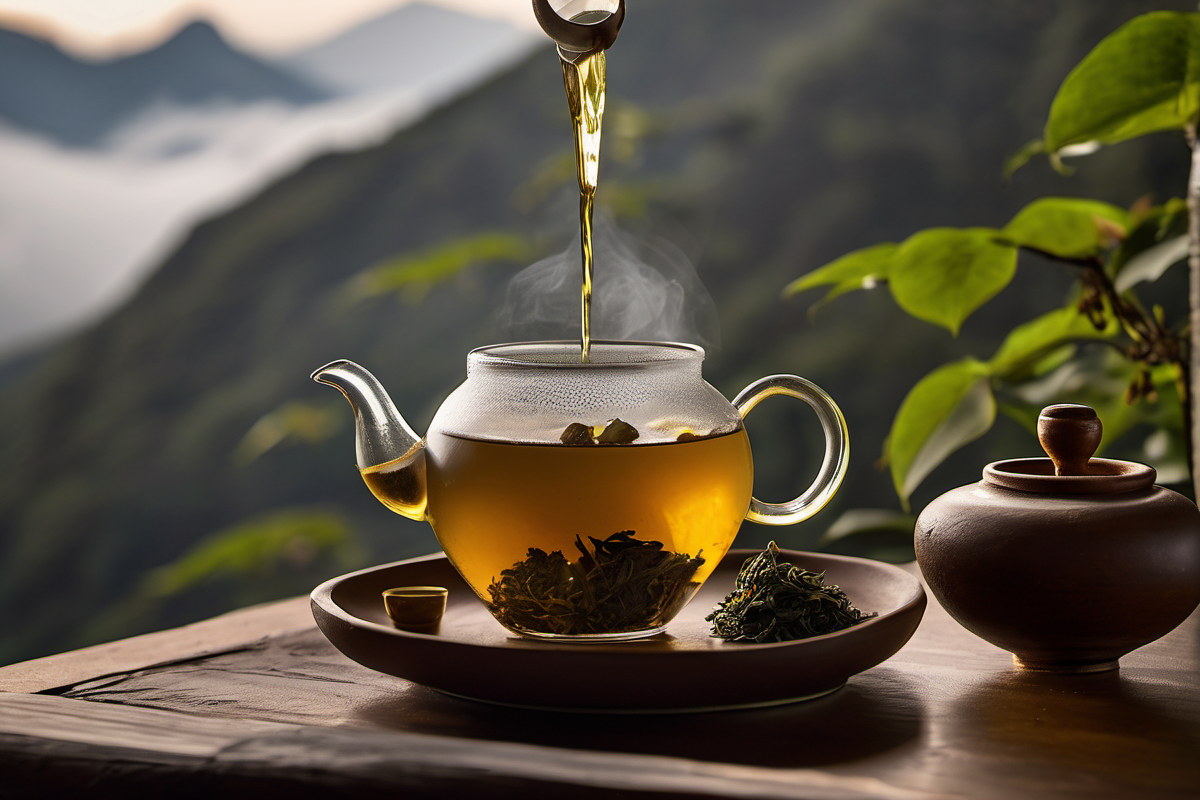
Dong Ding(凍頂烏龍,”Frozen Summit”)is one of Taiwan’s most famous teas and the traditional Taiwanese oolong most Western drinkers encounter first. Unlike lighter Chinese oolongs (Tieguanyin) or heavily-roasted Wuyi yan cha (Da Hong Pao), Dong Ding sits comfortably in the middle — gently roasted, smooth, forgiving, and full-flavored without being aggressive.
This guide walks you through exactly how to brew Dong Ding oolong at home, the right water temperature and leaf ratio, the gongfu method that shows off its character, and why this tea is more beginner-friendly than most oolongs.
If you’re new to oolong in general, start with our complete oolong brewing guide and our Tieguanyin vs Da Hong Pao comparison to understand the broader category. For gongfu technique basics, see our gaiwan brewing walkthrough.
The 30-Second Answer
- Water temperature: 95°C / 203°F(just off the boil)
- Gongfu ratio: 6–7 g per 100 ml gaiwan
- First steep: 30–40 seconds(after a quick rinse)
- Subsequent steeps: add 10 seconds each round
- Vessel: A Yixing clay teapot dedicated to Dong Ding is the traditional choice; a porcelain gaiwan also works
- Re-steeps: 8–12+ in gongfu
- Vibe: Forgiving — the roasting means a wider temperature and steep-time margin than lighter oolongs
Now let’s go deeper.
What Is Dong Ding Oolong?
Dong Ding is a traditional Taiwanese oolong tea from the Lugu area of Nantou County in central Taiwan. The name means “Frozen Summit” — referring to the mountain peaks where the tea was historically grown, often shrouded in fog and mist $TRAE_REF.
The tea has a history dating to the mid-19th century, when a scholar reportedly brought tea plants from mainland China and planted them in the Lugu mountains. It became one of the most famous teas in Taiwan and is now a protected designation $TRAE_REF.
What makes Dong Ding recognizable in the cup:
- Tightly ball-rolled leaves that unfurl dramatically during brewing
- Amber to deep gold liquor
- Roasted nut and honey character with toasted grain, ripe fruit, sometimes light orchid notes
- Smooth, full body with long-lasting huigan (returning sweetness)
- Many steepings — quality Dong Ding easily gives 8–12 gongfu infusions
Compared to other oolongs you’ve likely encountered:
| Tea | Region | Character | Closest to Dong Ding? |
|---|---|---|---|
| Tieguanyin(Anxi, Fujian) | Light, floral, vegetal | Far from Dong Ding | |
| Da Hong Pao(Wuyi, Fujian) | Heavy roast, mineral | Closer — but more aggressive | |
| Dong Ding(Lugu, Taiwan) | Medium roast, smooth, sweet, nutty | — | |
| High-mountain oolong(Alishan, Lishan) | Light, floral, dairy | Closer in body, but lighter roast |
The closest comparison is Da Hong Pao (both are roasted oolongs), but Dong Ding is smoother, sweeter, and more aromatic, while Da Hong Pao is deeper, more mineral, and more roasted.
What Makes Dong Ding Roasting Special
Traditional Dong Ding undergoes charcoal roasting over long-burning longan wood charcoal (hong bei, 烘焙) for hours or even days. This slow, low-temperature roasting drives the Maillard reaction, converting sugars in the leaf into complex nutty, toasted, and honey-like aromas $TRAE_REF. The result is a tea with the characteristic “charred but sweet” finish that distinguishes traditional Dong Ding from modern lightly-roasted versions.
Three main styles you’ll encounter:
– Traditional charcoal-roasted — heaviest, deepest roast; nutty, honeyed, sometimes smoky; best for traditional gongfu
– Modern medium-roast — lighter, more floral; bridges traditional Dong Ding and high-mountain oolong
– Lightly-roasted — almost like a high-mountain oolong; clean and floral
For brewing, medium to traditional-roasted Dong Ding gives the most distinctive character.
What You Need
| Item | Why it matters | Best choice | Budget option |
|---|---|---|---|
| Yixing clay teapot (100–150 ml) | Traditional vessel; develops character over time | Dedicated Dong Ding pot | 100 ml porcelain gaiwan |
| Variable-temp kettle | 95°C matters — boiling will over-extract | Adjustable kettle | Boil, wait ~30 sec |
| Scale (0.1 g) | Need 6–7 g per 100 ml — eye-balling leads to inconsistency | Small kitchen scale | Pre-measure and store |
| Fairness pitcher | Evenly distributes each infusion among cups | Glass or porcelain pitcher | Any small pitcher |
| Small tasting cups | 30–60 ml cups ideal | 4–6 small porcelain cups | Mugs work |
Yixing vs Gaiwan for Dong Ding
Traditional choice: a Yixing clay teapot dedicated to Dong Ding (or roasted oolongs in general). The clay is mildly porous and adds a subtle warmth and roundness to the cup.
Why not just any teapot?: Dong Ding is a roasted tea that benefits from clay’s warming character. A Yixing pot dedicated to roasted oolongs (Da Hong Pao, Rou Gui, Dong Ding, Tieguanyin nong xiang) lets the clay absorb and slowly release the roast character across sessions $TRAE_REF. A fresh gaiwan is neutral and shows the tea cleanly without the clay’s contribution.
If you’re just starting out, a porcelain gaiwan is the right choice — you can read the tea clearly and decide later if you want to invest in a clay pot. See our first gaiwan guide for what to buy.
For full teaware selection, see our gaiwan vs teapot comparison.
Step-by-Step: Gongfu Method (Recommended)
This is how Dong Ding was traditionally brewed in Taiwan and is the method that shows off its full character.
Step 1: Warm Everything
Pour hot water into your gaiwan or teapot, swirl, and discard into the cups. Then pour into the cups and discard. This pre-heats everything so the water temperature doesn’t drop when it hits the leaves.
Step 2: Add the Leaves
Use 6–7 g of leaf per 100 ml of vessel capacity $TRAE_REF. This is a higher ratio than Western brewing — necessary for short gongfu steeps to extract enough flavor.
Dong Ding leaves are tightly ball-rolled — they’ll look like small green-brown pellets in the dry form. 6–7 g fills about a quarter of a 100 ml gaiwan.
Step 3: The Rinse
Pour water at 95°C to cover the leaves, then immediately pour off and discard. The rinse does two things: washes off any residual roasting dust, and wakes up the tightly rolled leaves so the first real infusion extracts evenly.
Rinse time: 3–5 seconds — quick, not a steep.
Step 4: First Steep
Pour 95°C water, cover, steep 30–40 seconds $TRAE_REF. Pour completely into the fairness pitcher, then into cups.
Truly empty the vessel — leaving water on the leaves continues extraction and produces a bitter next round.
Step 5: Subsequent Steeps
Add about 10 seconds per round:
| Steep | Time | What you should taste |
|---|---|---|
| 1 (rinsed) | 3–5 sec | Discard |
| 1 (first infusion) | 30–40 sec | Nutty, sweet, light roast, hints of orchid |
| 2 | 40–50 sec | Honey emerges, body firms up |
| 3 | 50–60 sec | Ripe fruit notes (peach, plum), full body |
| 4 | 60–70 sec | Caramel / brown sugar, longest huigan |
| 5 | 70–80 sec | Smooth, mellow, warm finish |
| 6–8 | 80–120 sec | Continuing smoothness, character becomes subtle |
| 8–12 | 120+ sec | Final rounds — clean, lightly sweet |
Quality Dong Ding gives 8–12 infusions $TRAE_REF. The character evolves — early steeps are bright and nutty, later steeps are mellow and sweet.
Step 6: Adjust to Your Taste
The table above is a starting point. Every Dong Ding is slightly different, and your water source and room temperature affect extraction. After the first 3–4 steeps:
- Too astringent or bitter? Drop the steep time by 5–10 seconds for the next round
- Too weak or thin? Add 5–10 seconds, or use slightly more leaf next time
- Losing flavor fast? Water temperature is probably too low — bump to 98°C
Western Method (Mug Brewing)
For everyday drinking, Dong Ding also works well in a mug or small teapot:
- Ratio: 3–4 g per 250 ml
- Water temperature: 90–95°C
- Steep time: 2–3 minutes
- Re-steeps: 2–3 times
You won’t get the layered progression of gongfu, but you’ll get a satisfying cup with most of the roast character intact.
For more on Western vs gongfu, see our complete brewing guide.
Why the Roasting Matters for Brewing
Traditional charcoal-roasted Dong Ding behaves differently in the cup than lightly-oxidized, unroasted oolongs:
| Trait | Lightly oxidized oolong | Charcoal-roasted Dong Ding |
|---|---|---|
| Water temperature | 85–95°C (sensitive) | 95°C (forgiving) |
| Steeping tolerance | ±5 seconds before bitterness | ±10–15 seconds before bitterness |
| Flavor development | Quick to peak, then fades | Slow build, sustains many steeps |
| Body | Light, aromatic | Full, rounded |
| Astringency | Can be sharp if overbrewed | Smooth even at moderate overbrewing |
The roasting smooths out the leaf’s rough edges. That’s why Dong Ding is more forgiving than Tieguanyin for beginners — you have a wider margin for error.
But don’t go too hot. Boiling water (100°C) on even roasted oolong extracts harsh compounds that aren’t part of the intended flavor profile. Stick to 95°C.
Common Mistakes
Boiling Water
Even though Dong Ding is more forgiving than lighter teas, 100°C water will still over-extract. Always let boiling water rest for 30–60 seconds before pouring, or use a variable-temp kettle set to 95°C.
Steeping Too Short
Many Western tea drinkers default to “1–2 minutes” for everything. For gongfu, that’s too long on the first steep. First infusion is 30–40 seconds — not minutes. This is the most common mistake when brewing Taiwanese oolong gongfu-style.
Using a Yixing Pot for Other Teas
If you buy a Yixing pot for Dong Ding, dedicate it to roasted oolongs only. Using the same pot for Tieguanyin (floral) and Dong Ding (roasted) will muddy both flavors over time. This is the rule for all Yixing pots — one pot per tea family.
For full Yixing guidance, see our gaiwan vs teapot comparison.
Reusing Leaves Without Rinsing
Some Western drinkers skip the rinse. With tightly ball-rolled leaves like Dong Ding, the rinse is functional, not ceremonial — it opens the leaves so the first real infusion extracts evenly. Skip it and your first cup will be weak.
Brewing With Chlorinated Water
Chlorine reacts with tea polyphenols to produce a flat, papery flavor. If your tap water is chlorinated, use filtered or spring water. This matters more for oolong than for black or roasted teas.
How to Tell Good Dong Ding from Bad
When you open the package:
- Dry leaf should be tight balls, not loose or open — loose leaves indicate age or poor rolling
- Aroma should be present immediately — nutty, sweet, lightly toasted. If it smells flat or papery, the tea is past prime
- Wet leaf should be whole and intact after brewing, not broken or powdery
- Liquor should be clear amber to deep gold, never cloudy or brown
For traditional charcoal-roasted versions, look for:
– Visible roast character in the dry leaf (slight darkening vs green)
– Honey or caramel note in the aroma — this comes from the Maillard reaction during roasting
– Long, sweet huigan in the cup
Storage
Dong Ding is more stable than lighter teas thanks to the roasting:
- Airtight container (the original tin or pouch is fine)
- Cool, dark, dry — a kitchen cupboard is okay
- No refrigeration — moisture cycles can ruin roasted teas
- Use within 18–24 months for peak quality; roast character fades slightly with age
For full storage principles across all tea types, see our complete storage guide.
Common Questions
What’s the Difference Between Dong Ding and Tieguanyin?
Both are oolongs, but they’re from different countries (Taiwan vs mainland China) and have very different characters:
- Dong Ding — Taiwan, roasted, nutty and smooth, ball-rolled leaves
- Tieguanyin — Fujian, light floral and creamy (in modern green-fresh style) or roasted (in nong xiang style)
If you love a smooth, nutty cup → Dong Ding. If you love a light, floral, buttery cup → Tieguanyin (green-fresh).
Is Dong Ding the Same as High-Mountain Oolong?
No, though they’re both Taiwanese oolongs. The distinction:
- Dong Ding — traditionally from Lugu area, mid-elevation (~700m), roasted, ball-rolled
- High-mountain oolong — from Alishan, Lishan, Dayuling (above 1000m), unroasted or very lightly roasted, more floral and dairy
Dong Ding has more body and roast; high-mountain has more delicate florals. See our Tieguanyin vs Da Hong Pao comparison for the broader oolong spectrum.
How Many Times Can I Re-Steep Dong Ding?
8–12 times in gongfu. Quality traditional Dong Ding keeps developing across many infusions. By the 8th steep you’re in subtle, sweet territory; by the 12th it’s a whisper of the original cup, but still pleasant.
Is Dong Ding High in Caffeine?
Moderate — about 30–50 mg per cup when brewed gongfu. Similar to Tieguanyin and other mid-roast oolongs. Fine for morning and afternoon; cut off by mid-afternoon if you’re caffeine-sensitive. For details, see our caffeine guide.
Why Are Some Dong Ding So Different From Each Other?
Three big variables:
- Roast level — traditional charcoal (deepest) vs modern medium vs light
- Elevation and growing region — Lugu original is ~700m; modern Dong Ding can come from other areas
- Harvest season — winter harvest is generally sweeter and more aromatic than summer
Try a few different versions before settling on a favorite.
Can I Brew Dong Ding in a Mug?
Yes — see the Western method above. 3–4 g per 250 ml at 90–95°C for 2–3 minutes gives a satisfying cup. You’ll get fewer infusions (2–3 instead of 8–12), but it’s perfect for casual drinking.
What If My Dong Ding Tastes Bitter?
Bitter Dong Ding is usually over-extracted or over-roasted for your taste. Try:
- Lower temperature by 5°C (90°C instead of 95°C)
- Cut the first steep to 20 seconds
- Use less leaf (5 g instead of 7 g)
If the bitterness persists across multiple changes, the tea itself may be too heavily roasted for your preference — try a different batch labeled “medium roast” or “modern style.”
Should I Use a Gaiwan or a Yixing Teapot?
Beginners: gaiwan. It’s neutral and lets you taste the tea clearly.
Traditional / experienced: a Yixing clay pot dedicated to roasted oolongs adds warmth and roundness, especially after the pot has been seasoned through months of use.
Either works. The tea is forgiving enough that you’ll get a good cup either way.
How Do I Know If My Dong Ding Is Fresh?
Fresh-roasted Dong Ding (within 6–12 months of production) has:
- Brighter, more floral top notes alongside the roast
- More visible “huigan” (returning sweetness)
- Cleaner aroma when you open the package
Older Dong Ding (12–24 months) has:
- Deeper, more settled roast character
- Mellow, less aromatic top notes
- Still pleasant, just less vibrant
Both are good — it’s a matter of taste. Vintage Dong Ding (3+ years) develops a unique aged character that some connoisseurs prize.
Further Reading
- How to Brew Oolong Tea — the broader category method
- Tieguanyin vs Da Hong Pao: Which Oolong Is Right for You? — the side-by-side comparison
- How to Brew Tieguanyin — the floral sister tea
- How to Brew Da Hong Pao — the roasted rock oolong
- Gaiwan vs Teapot: Which Should You Buy First? — vessel choice
- How to Choose Your First Gaiwan — buying teaware
- How to Store Chinese Tea — keeping your tea fresh
- How Much Caffeine Is in Chinese Tea? — caffeine numbers
- What Is Oolong Tea? — the broader category context
- How to Brew Chinese Tea (Complete Guide) — the foundational method