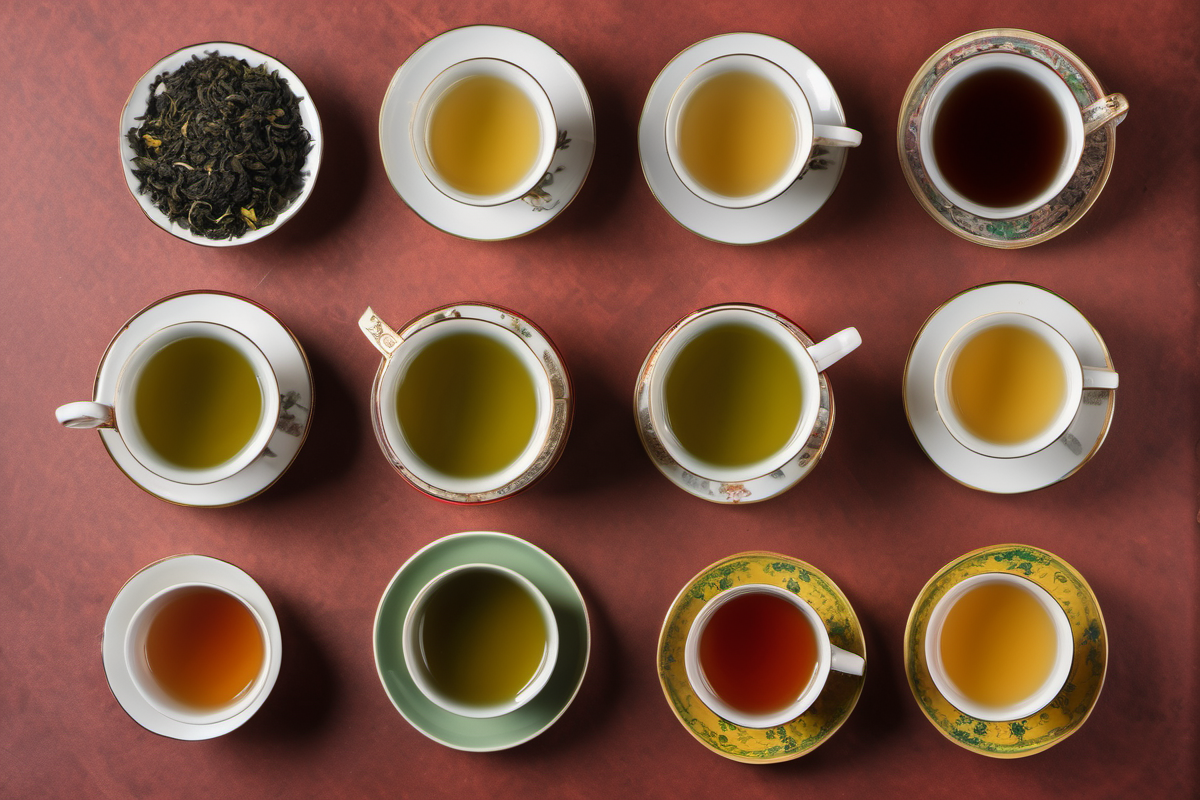
Walk into a tea shop and you’ll see dozens of names — Dragon Well, Iron Goddess, Silver Needle, Big Red Robe. They all fall into six categories of Chinese tea, determined by how the leaves are processed.
This guide explains the six types of Chinese tea, what makes each unique, and the famous teas you should know.
The 6 Types of Chinese Tea
| Type | Oxidation | Flavor | Brew temp |
|---|---|---|---|
| Green | None | Fresh, grassy, vegetal | 160–180°F |
| White | Minimal | Delicate, sweet, subtle | 175–185°F |
| Yellow | Slight | Mellow, smooth | 175–185°F |
| Oolong | Partial | Floral to roasted | 185–205°F |
| Black (red) | Full | Bold, malty, sweet | 200–212°F |
| Dark (pu-erh) | Fermented | Earthy, deep, aged | 200–212°F |
1. Green Tea (绿茶)
Unoxidized — the leaves are heated soon after picking to stop oxidation, preserving a fresh, grassy flavor.
- Famous examples: Longjing (Dragon Well), Biluochun (Green Snail Spring), Huangshan Maofeng.
- Note: green tea is the most delicate — use cooler water (160–180°F) or it turns bitter.
2. White Tea (白茶)
Minimally processed — simply withered and dried, giving a light, sweet, subtle brew.
- Famous examples: Silver Needle (Baihao Yinzhen), White Peony (Bai Mudan).
- Note: white tea is great for beginners — it’s hard to over-brew.
3. Yellow Tea (黄茶)
Slightly oxidized through a rare, extra “smothering” step — producing a mellow, smooth tea that’s the least common category.
- Famous example: Junshan Yinzhen (Jun Mountain Silver Needle).
4. Oolong Tea (乌龙茶)
Partially oxidized (10–80%) — the broadest category, from light and floral to dark and roasted.
- Famous examples: Tie Guan Yin (Iron Goddess), Da Hong Pao (Big Red Robe), Dan Cong.
- Note: the classic tea for gongfu brewing.
5. Black Tea (红茶, “Red Tea”)
Fully oxidized — in Chinese it’s called “red tea” for the color of the brew, giving a bold, sweet, malty flavor.
- Famous examples: Keemun (Qimen), Dianhong (Yunnan black), Lapsang Souchong (smoked).
- Note: the most familiar style to Western tea drinkers.
6. Dark Tea / Pu-erh (黑茶)
Fermented — undergoes microbial fermentation (and often aging), giving deep, earthy, complex flavors.
- Famous examples: pu-erh (sheng and shou), Liu Bao, Fu Zhuan.
- Note: like wine, good pu-erh improves with age.
Which Should You Try First?
- Brand new to tea? Start with a green (Longjing) or white (Silver Needle) — light and easy.
- Like bold flavors? Try a roasted oolong (Da Hong Pao) or black tea (Keemun).
- Want to explore? Pu-erh is the most unique — nothing else tastes like it.
Bottom line: all Chinese tea comes from one plant — the six types are six different ways of processing it, each with its own flavor and brewing style.
7 thoughts on “Types of Chinese Tea: Complete Guide”